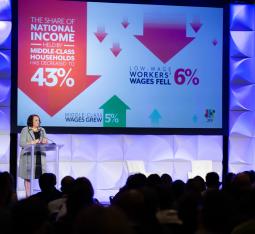
Despite the lowest national unemployment rate in 18 years, Maria Flynn, president and CEO of nonprofit JFF (Jobs for the Future), remains concerned about America’s workforce. She is particularly concerned about the decrease in share of the national income held by middle-class households that has fallen to 43 percent—the lowest level since the Pew Research Center began publishing income-share data in 1967.
As the head of a nonprofit that focuses on the alignment and transformation of the American workforce and education systems, Flynn has made the reversal of this downward trend a top priority—and that includes pursuing new and innovative solutions to tackle this multi-decade challenge.
Following JFF’s national Horizons summit held recently in New Orleans, JFF announced the $1 Billion Wage Gain Challenge, in partnership with Schmidt Futures’ Alliance for the American Dream. The Challenge was established to find innovative ideas that will raise the wages of at least 100,000 workers by $10,000 or more by 2021. But, JFF believes that multiple other outcomes will come from the Challenge as well.
“Our goal is really to generate more and more interest on this topic and to really shine a light on the wage stagnation issue and the importance of coming up with solutions that scale. Our hope is that other corporations and foundations will contribute to investing in the solutions,” Flynn said.
Flynn believes the timing of the Challenge announcement immediately following the conference reflects the two sharing the same goals. One major goal is for JFF’s initiatives to serve as a bridge among the many silos of those also concerned about the wage gap in America.
The diversity of the conference’s 800 participants is the beginning of the breakdown of those silos, drawing together philanthropic funders, government representatives, and education workforce leaders, along-side entrepreneurs and venture capitalists. The former group represents the more established traditional approaches to solving the wage gap, while the startups and venture capitalists bring new innovative approaches.
“We brought together a lot of different voices to look at the issues that today are sitting at the intersection of the future of work debate and the issues around economic advancement,” Flynn said. “By bringing many voices together to look at actionable solutions moves beyond the conversation and debate to undertake bolder scalable actions.”
Leading the challenge is JFFLabs, the innovation engine of JFF that incubates big innovative ideas such as the Wage Gain Challenge. JFFLabs works to serve as a bridge for moving traditional education and workforce systems, such as community colleges and workforce boards, toward more aligned collaboration with the growing number of mission-aligned startups in the education-workforce space—who can bring technology solutions and products that can scale.
“We are leveraging JFF’s long history of programmatic expertise, network building and policy work to start to bring those worlds together. So, it is about how we can accelerate mission-aligned startups who are bringing fresh eyes and big ideas to the space that JFF is working on, in addition to the ideas that come from the traditional system players,” Flynn said.
The idea for the Challenge emerged from discussions within JFF that aligned with thoughts and actions at Schmidt Futures. Schmidt Futures, through the Alliance, recently established a network of four communities anchored by a research university to explore solutions to the wage gap, as well as the range of challenges facing middle-income communities across America. The four universities are: Arizona State University, Ohio State University, University of Utah and University of Wisconsin.
JFF is leveraging the resources of the Alliance and the work underway through the network of communities and research universities. Schmidt Futures is assisting JFF with the design and running of the competition, including contributing part of the cash prize.
JFF will open the application for the Challenge nationwide on Labor Day, opening it to all U.S.-based individuals, nonprofit organizations, academic institutions and for-profit businesses. The Challenge will have three submission categories. One category will focus on existing solutions that have a track record and are ready to scale. The second will focus on emerging innovative ideas that will require time for development. A third category is for more experimental concept solutions that could be part of an existing approach or strategy that works through partnering.
JFF is casting a wide outreach to create a diverse panel of expert judges who will select the winners in early 2019. It will include labor economists who are experts on wage stagnation, private-sector leaders leaning into this issue, entrepreneurs working in the space, and public-sector representatives.
The winning proposals will be provided the opportunity to have their ideas implemented through a collaborative comprised of investors and JFF partners who will be involved in piloting and scaling the solution.
Flynn is quite excited about the prospect of introducing innovative ideas to address this deeply rooted problem. She feels that keeping the wage gap issue front and center is also part of the overall challenge. It includes gaining and keeping the attention of the media so they publicize some of the alarming statistics relating to demographic groups—which Flynn sees as sobering.
“Schmidt Futures has been thinking about these issues for a long time, going back to the Obama administration,” Flynn shared. This is a great way to come together and partner around an issue that both organizations feel very passionate about.”
Related posts:
- Schmidt Futures Supports American Dream Ideas Challenge with $1 Million Grand Prize to Winning Utah Proposal
- Schmidt Futures and Rhodes Trust Partner to Launch “Rise” Program for Young Leaders Taking on the Globe’s Biggest Issues
- Strategic Partnership between LDJ Productions and Anvil Venture Partners Supports LDJ | FUTURES Accelerator
- MINI and HAX Futures Launch New Seed Accelerator
- Gender Wage Inequality Study by ADP Research Institute Offers More Insight