Using a DAF, Yosemite has made substantial grant funding available to cancer researchers whose works are not investor-ready.
Yosemite, a venture capital firm with the mission of “making cancer non-lethal,” is blending philanthropy with venture investing. It recently surpassed $18 million in grants since launching in 2023. It became independent of the Emerson Collective, where it began in 2015.
That recently announced milestone reflects a growing strategy among science-driven investors. That is to fund the earliest, riskiest research through philanthropic vehicles and then support those with the greatest promise.
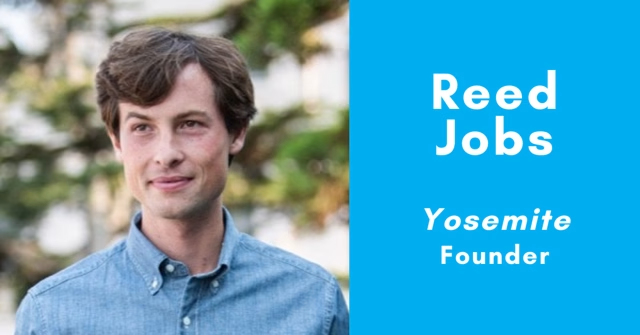
Founded by Reed Jobs, the son of Steve Jobs, the fund leverages traditional academic-industry partnerships and uses philanthropic capital to seed pioneering scientific research.
Its grantmaking runs through a donor-advised charitable vehicle, operating alongside Yosemite’s for-profit investment activity. The goal is to accelerate scientific ideas that often sit too early in the pipeline for traditional venture capital. They are also too uncertain for many conventional academic funding routes.
“Academic seed funding is essential to the evolution of cancer care,” said Jobs, who is also Yosemite’s Managing Partner. “Our donor-advised fund strategy enables us and our community to support ambitious, foundational work at its earliest stages and help move promising science toward translation.”
Filling the funding gap in advance of “venture-ready” science
Researchers working on early academic projects compete for limited grant dollars. That often requires substantial preliminary data before they can secure meaningful support.
That requirement can be a disadvantage to “high-risk, high-reward” concepts, including platform approaches that may not fit neatly into existing funding categories.
Yosemite’s model is designed to intervene earlier. It supports preclinical experiments, novel hypotheses, and tool-building efforts that can redefine how cancer is detected, understood, and treated.
One example cited in the announcement is preclinical research led by Craig Crews at Yale. It helped generate foundational insights that contributed to the formation of Quarry Thera. The biotechnology company is developing small-molecule drugs intended to modulate protein interactions in new ways, with potential applications in cancer and autoimmune diseases.
This type of pathway, academic insight to translational proof points to company formation, has long been central to biotech innovation. Yosemite’s approach aims to increase the odds for promising early work to survive long enough for traditional investment and partnering to take over.
A cornerstone partnership with the American Cancer Society
A major channel for Yosemite’s philanthropic work is its ongoing partnership with the American Cancer Society (ACS). It is one of the largest cancer research funders in the United States. Through the collaboration, Yosemite and ACS annually identify emerging research areas aligned with shared scientific priorities. They then support selected projects through an ACS–Yosemite grant cycle.
“We are excited to partner with Yosemite for the second year, expanding our ability to fund innovative projects that can have real and practical implications for cancer patients,” said Bill Dahut, M.D., Chief Scientific Officer at the American Cancer Society.
Past focus areas have included AI in cancer research, the tumor microenvironment, cancer vaccines, and cancer-targeted toxin delivery. The mix reflects both the expansion of computational methods in oncology and the continued push for more precise therapies.
The 2025 ACS–Yosemite awardees span emerging investigators and widely recognized scientific leaders, including Carolyn Bertozzi, Jennifer Doudna, William Kaelin, Kai Wucherpfennig, and Stephen Elledge.
Yosemite also pointed to early evidence of scientific momentum from the partnership. A supported project led by Jeremiah Johnson’s group at MIT, published in Nature Biotechnology, developed a next-generation antibody-based drug-delivery approach. It enables each antibody to carry more drug molecules than conventional antibody-drug conjugates. In preclinical models of breast and ovarian cancer, the approach demonstrated stronger anti-tumor activity.
“This support allowed us to pursue a high-risk, high-reward direction that would have been difficult to fund otherwise,” Johnson said. “The ACS–Yosemite partnership created the flexibility and momentum needed to move the work quickly from concept to publication.”
Directed healthcare grants aimed at real-world cancer care delivery
Yosemite is also deploying grants to healthcare initiatives aimed at improving cancer care delivery at major institutions, including the Mayo Clinic and City of Hope. These directed grants focus on practical challenges across the cancer care continuum—from diagnosis to treatment decisions to survivorship.
Key areas of emphasis include improving diagnostic accuracy and efficiency by leveraging new digital and physiological signals. They monitor patient health and predict disease risk, and inform care and treatment decisions through integrated data and clinical intelligence.
At the Mayo Clinic, the funding is applied across clinical programs and research settings. Cheryl Willman, M.D., Executive Director of Mayo Clinic Cancer Programs and Director of the Mayo Clinic Comprehensive Cancer Center, said the philanthropic support will help advance Mayo’s work “to transform cancer research and care, from early detection through survivorship.”
At City of Hope, Yosemite’s support is aimed at accelerating translation, moving research advances into routine clinical practice faster. John Carpten, Ph.D., Chief Scientific Officer at City of Hope and Director of the City of Hope Comprehensive Cancer Center, emphasized the value of “ambitious and innovative teams in AI, diagnostics, and care delivery” to speed integration of breakthroughs into everyday oncology care.
Why this hybrid model matters now
Yosemite’s announcement occurs when many academic researchers see funding as more competitive and time-intensive, even as the scientific opportunities in oncology expand.
AI-driven discovery, advanced drug delivery, immunotherapy innovations, and better diagnostics are all opening new pathways, yet investors are reluctant to fund early-stage work that has so much uncertainty.
By combining a donor-advised fund platform with venture investing, Yosemite is positioning itself as an end-to-end supporter of oncology innovation. It is filling an important gap.
Looking ahead, Yosemite says it will remain an active vehicle for supporting early-stage cancer research and care initiatives. While philanthropic support is expected to play an increasingly important role in foundational work that leads to future translational and clinical efforts.
For more information, the firm directs inquiries to grants@yosemite.co.
Related posts:
- Tennessee’s Innovation Ecosystem Gets a $1.38B Boost from LIS Technologies’ Investment in Oak Ridge
- Startup302 info session scheduled online December 14
- Salt Security Strengthens Executive Leadership Team as Demand for API Security Accelerates
- Enterprise Blockchain Continues Growth, its Trust & Security Greatly Valued
- Apptronik Closes $350M in Funding to Meet Surging Demand for Humanoid Robots, Gains Google Investment