Varda’s co-founders identified an advantage of drug development in space: microgravity can enable different crystal structures, potentially transforming drug manufacturing and lowering costs.
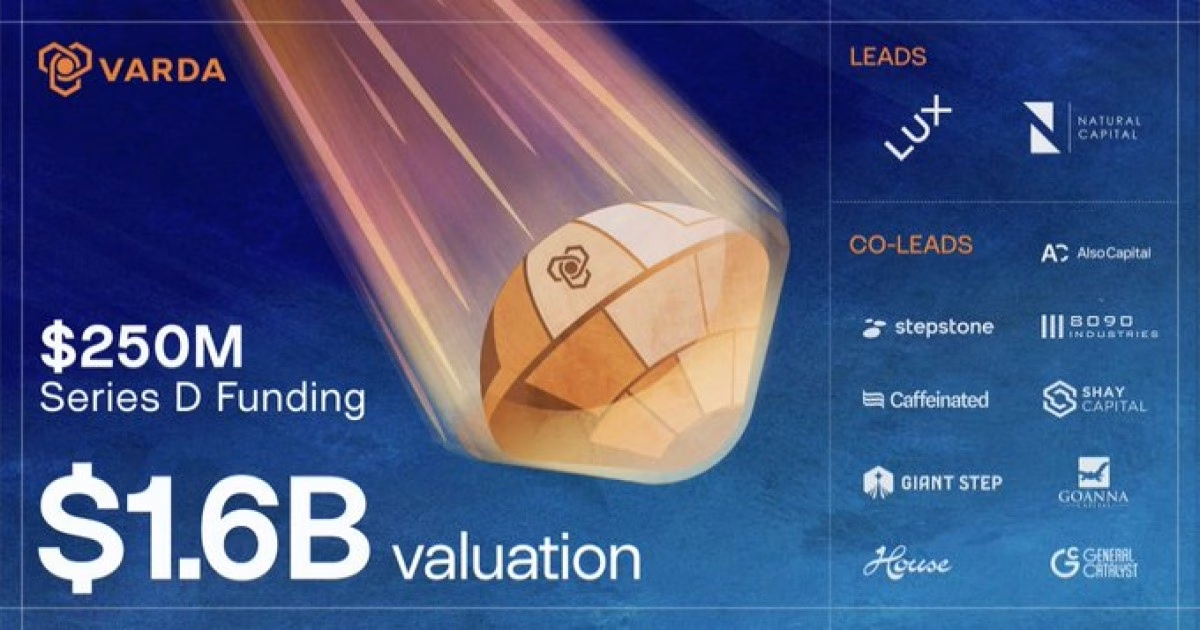
The company has raised $250 million in Series D funding as it moves closer to an ambitious goal: producing pharmaceuticals in space that can ultimately be used by patients on Earth.
The El Segundo, California-based company announced the financing on September 30, bringing its total capital raised to $598 million. Lux Capital and Natural Capital led the round, with participation from Founders Fund, Khosla Ventures, Caffeinated Capital, General Catalyst, 8090 Industries, Giant Step and Also Capital.
Founded in January 2021 by Will Bruey and Delian Asparouhov, Varda was built on the idea that lower launch costs could make commercial manufacturing in low Earth orbit economically viable.
Bruey previously spent years as an engineer at SpaceX, while Asparouhov is a partner at Founders Fund.
The team focused on microgravity because scientists can potentially create different crystal structures and particle characteristics that may enable new drug formulations or improve how medicines are manufactured and delivered.
This contrasts with Earth-based, gravity-driven processes like sedimentation and convection, which can affect crystal formation.
Researchers aboard the International Space Station have studied pharmaceutical crystallization and other forms of microgravity manufacturing for decades. Varda’s strategy is to move that work from experimental research toward a repeatable commercial manufacturing process.
“We started Varda with the conviction that the first product manufactured in space and consumed on Earth would be a pharmaceutical,” co-founder and President Delian Asparouhov said in announcing the Series D.
The new capital will allow Varda to increase its flight cadence, expand pharmaceutical partnerships, and move closer to producing medicine in orbit.
From Space Experiment to Commercial Platform
Varda has already demonstrated the basic concept.
Its first W-Series spacecraft launched in June 2023 carrying pharmaceutical-processing equipment. During the mission, Varda grew crystals of Form III of ritonavir, an antiviral drug used in HIV treatment. The capsule successfully returned to Earth in February 2024, landing at the Utah Test and Training Range.
Since that first launch,Varda has accelerated its mission schedule. The company says it has now completed six successful reentries and has more than a dozen additional launches and reentries planned through 2028.
Its W-Series system combines orbital processing with a reusable model for returning valuable materials to Earth. After pharmaceutical experiments or manufacturing processes are completed in orbit, a capsule separates from its spacecraft. It reenters Earth’s atmosphere at more than 18,000 miles per hour—approximately Mach 25—before landing by parachute for recovery.
That reentry capability has applications beyond pharmaceuticals. Varda’s capsules also give government customers a platform to test technologies under actual hypersonic flight conditions, creating another commercial market as the company builds its space-manufacturing infrastructure.
Varda is now positioning itself at the intersection of two rapidly developing industries: commercial space infrastructure and biotechnology. Its challenge is no longer simply proving that useful pharmaceutical processing can occur in microgravity.
The company is working to make launching, manufacturing, and returning products from orbit routine enough to become another step in the pharmaceutical development pipeline.
If Varda succeeds, space manufacturing could evolve from specialized scientific experimentation into an entirely new component of the life sciences industry—with medicines among the first products routinely manufactured beyond Earth.
Related posts:
- Voltropy’s Breakthrough Vast-10M AI Model With 10 Million-Token Context Window Raises Processing Bar
- Good Good Golf Raises $45M to Drive Global Expansion Across Media, Retail, and Live Experiences
- Canadian Venture Capital Totals $2.9 Billion in First Half of 2019, on Track to Surpass $5 Billion
- Jonathan Rose Companies’ $660M+ Fund Commits to the Greening of Affordable Housing in Urban Areas
- Student Business Competition Takes Rider University’s Entrepreneurial Program Boldly Forward