Founded in 2017, SambaNova, the full-stack AI infrastructure company, has pulled together three key elements: funding, a major collaboration, and the introduction of a new chip that will empower it to pursue further growth.
SambaNova believes the next phase of AI will be defined by the ability to run agentic AI quickly, cost-effectively, and at scale, rather than by the size of training clusters.
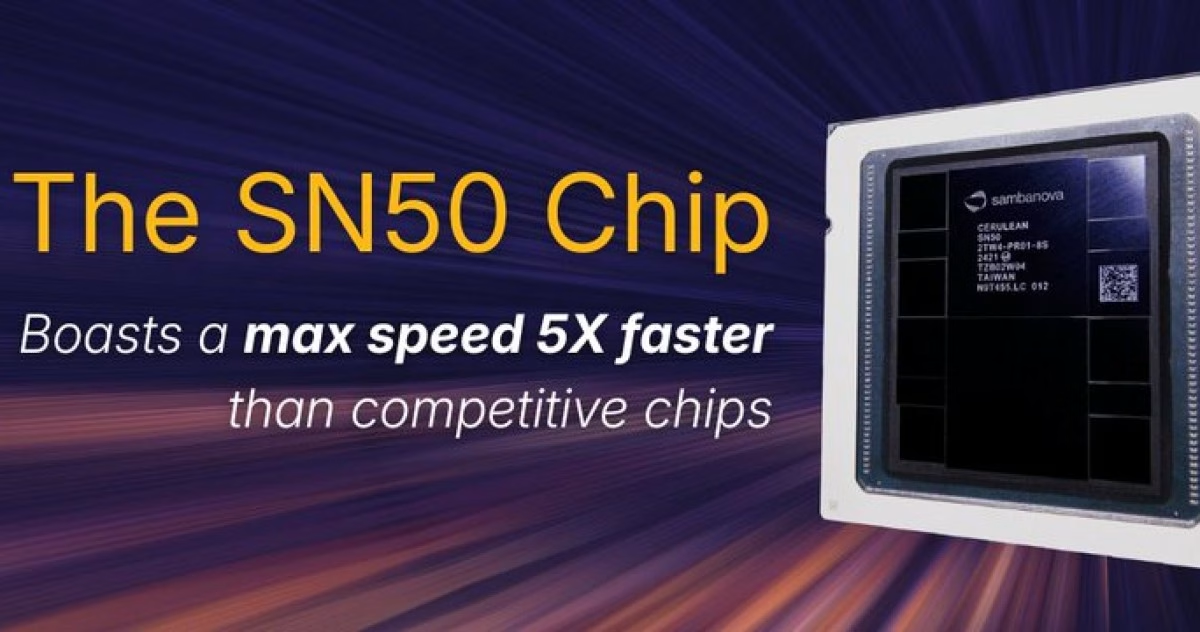
In a new announcement, the San Jose-based AI infrastructure company introduced its SN50 AI chip, positioning it as a purpose-built accelerator for production-grade agentic workloads.
Alongside the launch, SambaNova announced a multi-year strategic collaboration with Intel and disclosed more than $350 million in Series E funding to expand manufacturing and cloud capacity.
SambaNova states that SN50 delivers up to 5x the speed of competingchips and enables agentic AI at approximately 3x lower total cost of ownership than GPUs. This combination targets inference economics, which becomes critical as models transition from demonstration to production.
$350M+ Series E Funding: Vista and Cambium Lead, Intel Capital Joins
To support its expansion, SambaNova announced an oversubscribed $350 million Series E funding. Proceeds will be used to expand SN50 production, scale SambaCloud, and deepen enterprise software integrations.
SambaNova’s funding round was led by Vista Equity Partners and Cambium Capital, with strong participation from Intel Capital. New investors named in the release include Battery Ventures and accounts advised by T. Rowe Price Associates, Inc., among others, with existing investors also participating.
“We’re proud to be investing in SambaNova at such a pivotal time,” said Monti Saroya, Partner at Vista Capital, pointing to the need for infrastructure that meets production latency and cost requirements as agentic workloads expand.
Why “Agentic AI” Is the Battleground Now
Agentic AI systems perform more than simple prompt responses. They coordinate multiple steps such as routing requests, calling tools, switching models, retrieving context, and executing multi-turn reasoning workflows.
This orchestration can be costly due to increased inference calls, higher memory requirements, and greater sensitivity to latency.
“AI is no longer a contest to build the biggest model,” said SambaNova co-founder and CEO Rodrigo Liang. “With the SN50 and our deep collaboration with Intel, the real race is about who can light up entire data centers with AI agents that answer instantly, never stall, and do it at a cost that turns AI from an experiment into the most profitable engine in the cloud.”
More Compute, More Bandwidth, Bigger Models
SambaNova says SN50 is built on its Reconfigurable Data Unit (RDU) architecture and is tuned for the real-world constraints of enterprise inference: latency, concurrency, and predictable throughput.
According to the release, SN50 provides:
- Five times more compute per accelerator and four times more network bandwidth than the prior generation
- The ability to link up to 256 accelerators over a multi-terabyte-per-second interconnect
- Reduced time-to-first-token and support for larger batch sizes
- A three-tier memory architecture that the company says enables 10T+ parameter models and 10M+ context lengths
- “Resident multi-model memory” and “agentic caching” to optimize utilization and reduce infrastructure cost
In practical terms, SambaNova asserts that enterprises can operate larger, longer-context models with strong responsiveness, without incurring the high costs typically associated with GPUs.
IDC also weighed in on the broader significance of inference token economics. “The new SambaNova SN50 RDU changes the tokenomics of AI inference at scale,” said Peter Rutten, Research Vice-President, Performance Intensive Computing at IDC, citing high throughput, existing power compatibility, and air-cooled deployment as key differentiators.
SambaNova said SN50 will be shipping to customers later this year.
SoftBank Goes First: SN50 Heads to Japan Data Centers
A key aspect of the announcement is customer validation, particularly at the data center level.
SoftBank Corp. will be the first customer to deploy SN50 inside its next-generation AI data centers in Japan, using it to deliver low-latency inference services for sovereign and enterprise customers across Asia-Pacific.
The release notes the deployment will support both open-source and proprietary frontier models with demanding latency and throughput requirements.
“With SN50, we are building an AI inference fabric for Japan that can serve our customers and partners with the speed, resiliency and sovereignty they expect from SoftBank,” said Hironobu Tamba, Vice President and Head of the Data Platform Strategy Division of the Technology Unit at SoftBank Corp. “By standardizing on SN50, we gain the ability to deliver world-class AI services on our own terms—with the performance of the best GPU clusters, but with far better economics and control.”
SoftBank already hosts SambaCloud for fast inference in the region, and this deployment further strengthens the partnership, positioning SambaNova as a central element of SoftBank’s sovereign AI strategy.
With SoftBank as the initial deployment partner and Intel committing to a multi-year collaboration, SambaNova is positioning itself as a leading contender for the cloud inference layer that will support the next generation of autonomous AI systems.
Intel + SambaNova: A Multi-Year Push for GPU Alternatives
SambaNova’s planned collaboration with Intel targets the rapidly growing market for cloud-scale inference among AI-native companies, model providers, enterprises, and governments seeking alternatives to GPU-based solutions.
“Customers are asking for more choice and more efficient ways to scale AI,” said Kevork Kechichian, EVP and General Manager of Intel’s Data Center Group. Intel said the combination of its compute, networking, and memory with SambaNova’s “full-stack AI systems and inference cloud platform” will give organizations a compelling path to deploy advanced AI at scale.
The collaboration is expected to span three areas:
- AI Cloud Expansion – scaling SambaNova’s cloud on Intel Xeon-based infrastructure, optimized for LLMs and multimodal models
- Integrated AI Infrastructure – blending SambaNova systems with Intel CPUs, accelerators, and networking to support production inference for reasoning, code, multimodal apps, and agentic workflows
- Go-to-Market Execution – joint co-selling/co-marketing through Intel’s global channels
Intel also plans to make a strategic investment in SambaNova to accelerate the rollout of an “Intel-powered AI cloud.”
Inference Economics Is Becoming Strategy
SambaNova is a fully integrated end-to-end agentic AI stack, spanning across agents, models, knowledge, and data.
With key funding in place, Its chip launch signals that AI infrastructure is entering a phase where token economics, latency, and operational efficiency will increasingly determine which platforms achieve enterprise adoption.
Related posts:
- NJEDA Launches New Digital Platform to Connect State’s Innovation Ecosystem
- DENSO Broadens Investments in Self-Driving Car Technologies, Seeking Startups to Pitch at CES 2018
- EV Shuttle and School Bus Manufacturer Endera Gains $49 Million to Support Growth
- University Startup Hubs Partner to Boost Innovation and Entrepreneurship
- 2024 Film Industry Spending Breaks Yet Another Record in NJ