Founded in 2024, the company has received funding from a top venture capital firm focused on deep tech and innovative entrepreneurs working on solutions to complex challenges.
Building the next generation of AI infrastructure presents a host of complex challenges, from scaling compute and optimizing power delivery to managing high thermal loads.
However, one fundamental constraint that must be overcome for large-scale AI success is data center connectivity. This demand requires greater bandwidth, dramatically lower power consumption, and greater reliability than current solutions can offer.
PicoJool, an optical connectivity startup, has launched from stealth with $12 million in funding from Playground Global. The company now has the support to expand its operations to target the persistent bandwidth and cost limitations of copper-based connectivity in large-scale AI data centers.
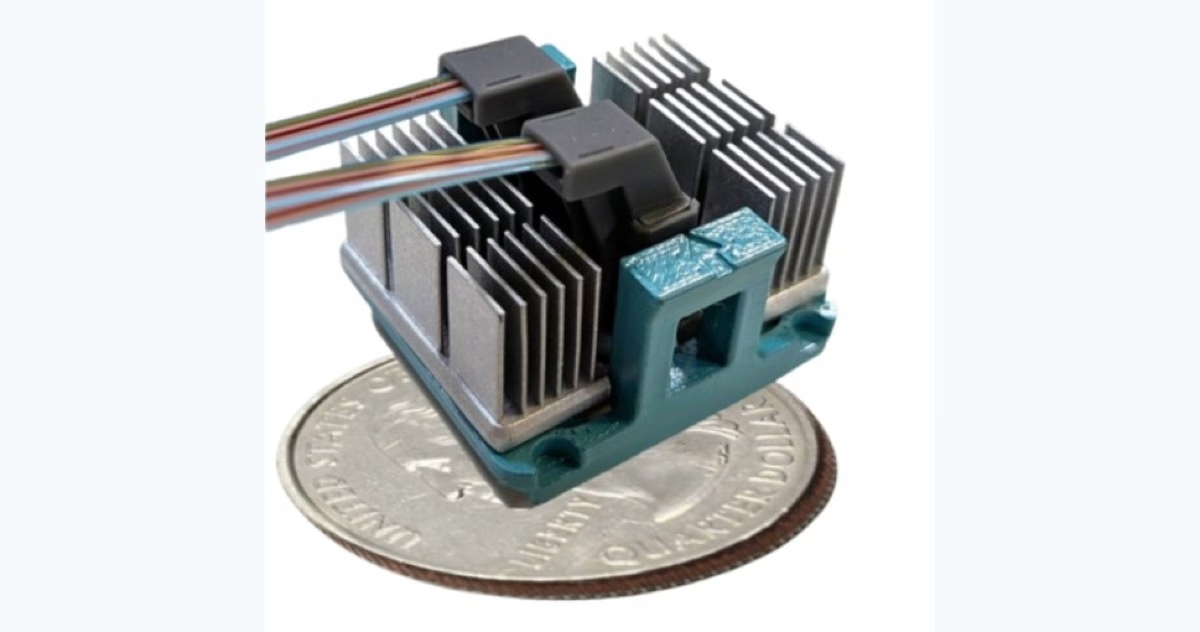
PicoJool will address these industry demands at a commercially viable cost via its pixel-level photonics, enabling fiber-based links that are as affordable, compact, and manufacturable as copper interconnects.
Overcoming the Longstanding Cost Barrier in Optical Technology
Optical connectivity offers significantly higher bandwidth, longer reach, and lower energy consumption for data centers. However, cost, complexity, and manufacturing challenges have limited its widespread adoption.
PicoJool says that era is over.
“By making high-bandwidth optical connectivity cost-competitive and manufacturable at scale, PicoJool is collapsing the cost and complexity barriers that have held photonics back for decades,” said Pat Gelsinger, General Partner at Playground Global. “This is exactly the kind of foundational shift we invest in at Playground.”
The company focuses on next-generation Vertical Cavity Surface Emitting Lasers (VCSELs), designed to deliver high bandwidth using advanced parallel optics and packaging techniques.
These optical chips integrate into parallel modules for direct deployment in large-scale AI computing environments.
According to PicoJool, this approach matches copper in performance while providing the reliability and reach of optical solutions.
Engineered for the Bandwidth Requirements of AI-Scale Computing
The rapid adoption of AI models, which require extensive calculations and parallelization across GPUs and custom accelerators, has revealed a growing bandwidth gap in modern data centers. As models and training clusters scale, copper interconnects encounter physical limits in speed, thermal efficiency, and signal integrity.
That challenge is precisely what inspired PicoJool founder and CEO Al Yuen, who has assembled a highly skilled team to complement his deep experience. He holds over 50 patents in the photonics space, including the inventions of connectivity technologies that form the backbone of the Internet: Active Optical Cables (AOC) and QSFP transceivers.
“The relentless demand for bandwidth in hyperscale and AI data centers requires a fundamental shift in connectivity,” Yuen said. “We must move beyond the physical and economic constraints of copper. This funding accelerates our deployment of high-reliability, cost-effective VCSEL technology across external foundries.”
With great depth of expertise, PicoJool aims to design and scale optical solutions supporting 800G, 1.6T, and future next-generation networking speeds essential for AI clusters.
Positioned at a Key Turning Point for the Industry
The transition from copper to optical has been anticipated, but progress was gradual until the recent acceleration driven by AI.
“AI-scale computing is the driving force for that conversion to happen now,” Gelsinger said. “PicoJool arrives at the precise moment the industry needs it most—where the demand for bandwidth meets the need for efficiency.”
PicoJool’s VCSEL technology is optimized not only for performance but also for manufacturability. The company says its approach enables cost-effective scaling through existing semiconductor fabrication partnerships, creating a pathway to high-volume production.
The architecture supports longer reach and greater network flexibility than copper, which is critical as data centers grow in size and computational density.
Expanding Operations in the U.S. and Taiwan
PicoJool is headquartered in Palo Alto, California, with R&D and manufacturing operations in the United States and Taiwan, a global center for advanced electronics. The new investment will expand these capabilities and advance R&D into next-generation optical architectures, including 400G/lane systems and future interconnect standards.
Aiming to Redefine Optical Communication
PicoJool’s launch marks more than the introduction of a new photonics startup. It reflects a significant shift in AI data center architecture and the increasing importance of optical connectivity as a mainstream solution.
As AI advances and models scale, companies that enable faster, more efficient, and cost-effective data movement will drive the next era of computing. PicoJool aims for its pixel-level photonics and VCSEL technology to play a central role in this transformation.
Related posts:
- Silna Health Secures $27 Million to Modernize America’s Prior Authorization System with AI
- Seven Stars Launches $40M Fund Backing Founders Shaping the Future of AI Applications
- MBDA Enterprising Women of Color: Ascend Capital Accelerator: Beauty Cohort Now Accepting Applications!
- Five New Entertainment, Technology, and Media Startups Selected for SPROCKIT Partnership Program
- Retail Shrinkage Addressed in Survey Released by NRF and University of Florida