The funding round was led by notable investors who recognized that Panthalassa’s ocean technology offers a solution to the growing demand from land-based data centers for electricity and cooling capacity.
Portland, Oregon-based Panthalassa has raised $140 million in Series B funding to manufacture and deploy autonomous ocean-powered computing systems designed to run AI inference at sea.
Peter Thiel led the round that included participation from a large group of technology, climate, infrastructure, and venture investors.
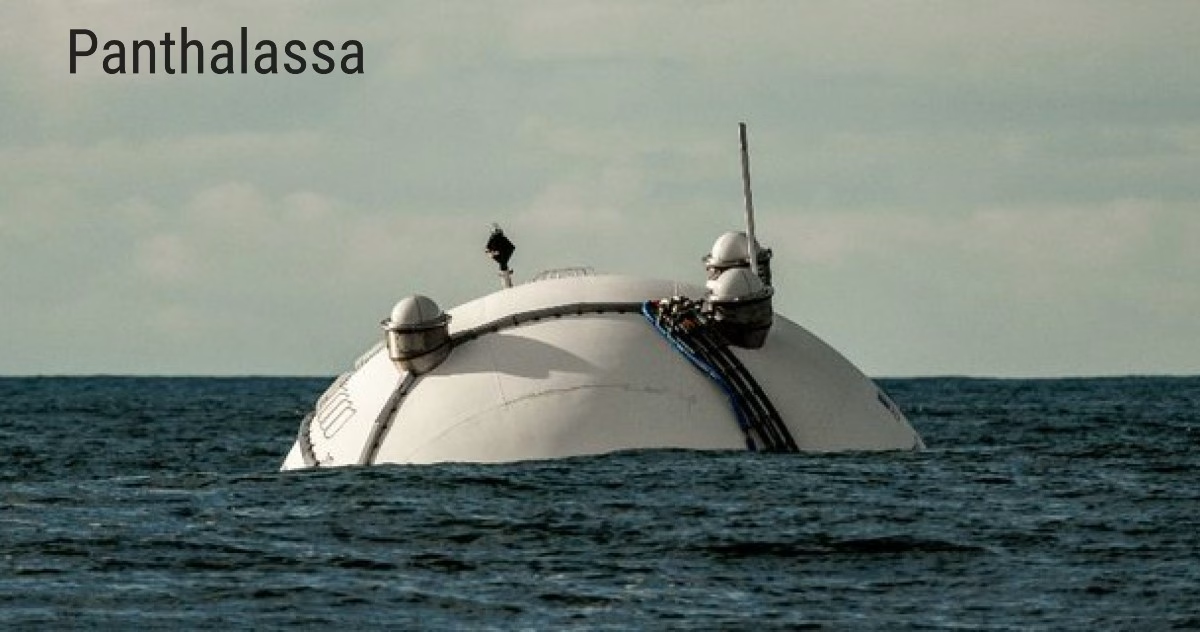
Panthalassa, a renewable energy and ocean technology company founded in 2016, announced financing to accelerate the development of what it describes as a new class of AI infrastructure: floating, self-powered ocean nodes that generate electricity from waves and use that power on board to run AI chips.
The Series B funding will help complete the company’s pilot manufacturing facility near Portland, Oregon, and support the first deployments of its Ocean-3 node series.
Panthalassa plans to deploy the Ocean-3 pilot nodes in the northern Pacific Ocean in 2026, with commercial deployments expected in 2027.
Panthalassa Targets AI Infrastructure’s Energy Problem
The financing comes as demand for artificial intelligence computing continues to increase pressure on the power grid, water resources and data center infrastructure.
AI data centers require large amounts of electricity and cooling capacity, creating challenges for utilities, local communities and companies racing to scale compute capacity.
Panthalassa’s approach is different from traditional land-based data center expansion. Instead of building new onshore facilities and connecting them to already strained power grids, the company is developing autonomous ocean systems that generate clean power from wave energy and use it directly on board.
Its nodes send AI inference tokens back to land using satellite connectivity. This model is designed to avoid the need to transmit electricity from offshore systems back to terrestrial grids, while using the surrounding ocean for cooling.
“There are three sources of energy on the planet with tens of terawatts of new capacity potential: solar, nuclear, and the open ocean,” said Garth Sheldon-Coulson, co-founder and CEO of Panthalassa. “We’ve built a technology platform that operates in the planet’s most energy-dense wave regions, far from shore, and turns that resource into reliable clean power.”
How Panthalassa’s Ocean-Powered AI Nodes Work
The nodes are autonomous floating energy systems manufactured in coastal factories from plate steel. Once deployed in the open ocean, they are designed to capture wave energy, generate electricity, power on-board AI chips, and transmit data back to land via low-Earth-orbit satellites.
According to the company, the ocean itself provides “free supercooling,” countering the heat generated by high-performance chips. It also potentially extends chip lifetimes.
The company has spent more than a decade developing the technologies behind the system, including power generation, propulsion, autonomy and at-sea computing. Its Ocean-1, Ocean-2 and Wavehopper prototypes tested core capabilities at sea in 2021 and 2024.
Peter Thiel Leads $140 Million Series B
In addition to Peter Thiel leading the Series B round, new investors include John Doerr, Marc Benioff’s TIME Ventures, Max Levchin’s SciFi Ventures, Susquehanna Sustainable Investments, Hanwha Asset Management (USA)’s venture fund, Anthony Pratt, Fortescue Ventures, Future Positive, WTI, Nimble Partners, Super Micro Computer, Sozo Ventures, Dylan Field, Planetary VC, Leblon Capital, Resilience Reserve, Portland Seed Fund and the Intrepid Oregon Fund.
Returning investors include Founders Fund, Gigascale Capital, Lowercarbon Capital, Unless, and WovenEarth.
“The future demands more compute than we can imagine,” said Thiel. “Extra-terrestrial solutions are no longer science fiction. Panthalassa has opened the ocean frontier.”
John Doerr also highlighted the strategic importance of the company’s approach, calling Panthalassa’s autonomous wave power system “a game changer” for clean power generation and global energy needs.
Why Ocean-Powered Computing Could Matter
Panthalassa is positioning its technology at the intersection of several major infrastructure trends: AI compute demand, renewable energy, grid congestion, water scarcity, and the need for more resilient power sources.
Offshore computing powered by wave energy could expand AI infrastructure without requiring new data centers or land-based power plants. The latter are facing long permit times, local opposition and utility constraints.
The model creates a new domestic manufacturing category tied to coastal production, renewable energy systems, and next-generation computing infrastructure.
Commercial Deployments Planned for 2027
Panthalassa’s next major milestone is the deployment of its Ocean-3 pilot node series in the northern Pacific Ocean in 2026. Those deployments are expected to demonstrate AI inference capabilities at sea and help refine the company’s manufacturing process.
If successful, the pilot program would prepare Panthalassa for commercial deployments in 2027.
As a public benefit corporation, the company’s broader mission is to unlock the energy potential of the ocean while building cleaner infrastructure for the future of computing.
Related posts:
- Haun Ventures’ New $1B Fund II and the Re-Architecture of Global Commerce
- Award-Winning Entrepreneur Kim Perell Launches Execution Factor Fund
- Edtech Funding Boosted by New VC Firm Juvo Ventures, Seasoned Founders pursuing Innovation in Education
- South by Southwest Hosts Historic Agreement Signed by U.S. SBA and DoD
- Florida Ranks as the Best State to Start a Business in 2025, according to WalletHub Report