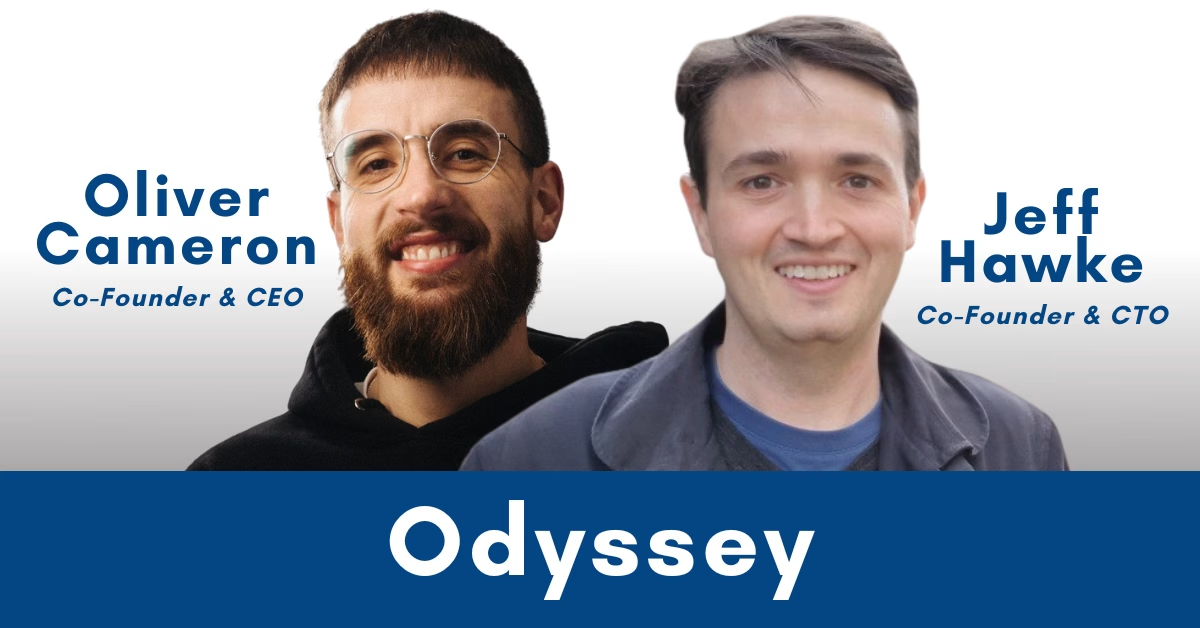
Odyssey, a Palo Alto-based AI lab developing advanced world models, has raised $310 million in Series B funding at a $1.45 billion valuation, marking one of the most significant recent financings in the emerging field of world simulation.
The round was led by Natural Capital, with participation from Amazon, AMD Ventures, GV, EQT, In-Q-Tel and other investors. Existing backers include Jeff Dean, Google’s chief scientist; Elad Gil; Qasar Younis, co-founder and CEO of Applied Intuition; Garry Tan, president and CEO of Y Combinator; Guillermo Rauch, founder and CEO of Vercel; and Kyle Vogt, founder of Cruise.
The round underscores growing investor interest in AI systems that move beyond language generation and toward models that can understand, predict and interact with simulated versions of the physical world.
Odyssey’s new capital will support additional research, infrastructure and broader deployment of its world model technology.
What Is World Simulation?
World simulation is an emerging area of artificial intelligence focused on building models that can recreate and predict how the real world works.
Instead of simply generating text, images, or video, a world simulation model attempts to understand cause and effect, physical movement, spatial relationships, sound, interaction, and change over time.
This means an AI system could simulate what happens when a robot moves through a room, when a vehicle responds to changing road conditions, when objects collide, or when multiple human and AI agents interact inside the same environment.
These systems are often called “world models.” They are designed to learn patterns from the real world and then use that knowledge to predict what comes next.
A strong world model could become foundational technology for robotics, autonomous systems, gaming, scientific research, healthcare training, education, defense and industrial simulation.
For startups and large technology companies, the promise is significant: if AI can simulate real environments with enough accuracy, it may reduce the cost and risk of testing in the physical world.
Robots could train in simulation before entering hospitals, warehouses or homes. Scientists could test complex scenarios. Game developers could create more interactive worlds. Autonomous systems could learn from simulated edge cases that would be difficult, expensive or dangerous to reproduce in real life.
Odyssey’s Bet on General World Models
Odyssey describes its work as focused on general world models: causal, multimodal systems that learn to predict and interact with the world over long horizons.
The company was founded by veterans of the self-driving car industry, a field that has long relied on simulation, sensor data, prediction and real-time decision-making.
That background is central to Odyssey’s positioning. Self-driving technology has been one of the most complex real-world AI challenges, requiring systems to interpret physical environments, anticipate movement and respond safely.
Odyssey is now applying that expertise to a broader AI platform designed to simulate many types of environments, not only roads.
“We believe world models represent a new class of foundation model—AI that can understand and simulate the world itself,” said Oliver Cameron, co-founder and CEO of Odyssey. “The last few years have seen major breakthroughs in scaling, interactivity, multimodality, and physics accuracy, and the field is now advancing extremely quickly.”
Cameron said the new funding provides the compute, infrastructure and partners needed to push the frontier of general world models and pursue what he called a “GPT-3 moment” for the field.
AWS Becomes Odyssey’s Preferred Cloud Provider
In addition to the financing, Odyssey announced a new agreement with Amazon Web Services, which will become the company’s preferred cloud provider.
The partnership gives Odyssey access to AWS infrastructure and specialized chips, including AWS Trainium, which is designed for high-performance AI training.
World models are among the most compute-intensive AI workloads because they must process large amounts of information while maintaining speed, accuracy and interactivity. Unlike static media generation, simulation requires the model to respond continuously as conditions change.
Ron Diamant, vice president and distinguished engineer at Amazon, said world models require “massive compute throughput with tight latency constraints.” He said AWS is excited to support Odyssey’s next phase of growth and collaborate on optimizing the company’s models on Amazon’s silicon.
The partnership also points to the strategic importance of infrastructure in the next wave of AI. As companies develop larger, more interactive and more physics-aware models, access to efficient compute may become a key competitive advantage.
Research Progress in Physics, Sound and Multi-Agent Interaction
Odyssey says it has made significant research progress over the past three years. Its Odyssey-2 Max system advanced physics accuracy for general world simulation.
Starchild-1 introduced a real-time multimodal world model, adding sound as part of the simulated experience. Agora-1 enabled multi-agent interaction within a shared world simulation, allowing multiple participants—human or AI—to interact in the same simulated environment.
The company has also demonstrated PROWL, a research approach showing how world models can improve through active exploration. In that model, AI systems can learn by seeking out weaknesses or failures in their own simulations and improving through interaction.
Together, these efforts reflect the broader direction of the field: moving from passive generation toward interactive, persistent, physically coherent simulations.
Why Investors Are Paying Attention
The investor group behind Odyssey reflects the broad commercial and strategic interest in world models.
Amazon’s participation aligns with the compute demands of next-generation AI and the company’s AWS infrastructure strategy.
AMD Ventures brings a semiconductor and AI hardware perspective. GV and EQT add venture and growth capital expertise. In-Q-Tel’s involvement points to potential national security, defense and intelligence applications.
Natural Capital, which led the round, described Odyssey as an ambitious technical team building toward what comes next in AI.
“At Natural Capital, we invest behind ambitious technical teams building what comes next,” said Jay Zaveri, general partner at Natural Capital. “We developed deep conviction in Odyssey’s research direction, technical leadership, and execution, which made this our largest investment to date. We believe they have the potential to help define AI beyond language models.”
Applications Across Robotics, Gaming, Science and Beyond
The potential applications for world simulation are wide-ranging.
In robotics, simulated environments could help machines learn complex physical tasks before deployment.
In gaming, world models could create more dynamic and responsive environments.
In science and healthcare, simulations may help researchers and practitioners test scenarios that are too costly or risky to conduct in the real world.
n education, world models could enable immersive learning environments where students interact with realistic simulations.
Defense and national security applications may also be significant, including training, planning and analysis in simulated environments.
Odyssey says its foundational technology has the potential to impact robotics, science, healthcare, education, gaming, defense and beyond.
The company’s team includes researchers and engineers from DeepMind, Tesla, Waymo, Meta, Apple and Wayve, with experience across language models, video models, world models and autonomous systems.
A New Frontier Beyond Language Models
The rise of large language models has shown how AI could understand and generate human language at scale. World models represent a different frontier: AI systems that can simulate environments, predict physical outcomes and interact over time.
For Odyssey, the $310 million Series B is not only a financing milestone. It is a bet that the next major platform shift in AI will come from models that understand the world, not just words.
With backing from major technology, venture, infrastructure and strategic investors, Odyssey is positioning itself as one of the companies aiming to define that next phase.
Related posts:
- Twenty Achieves Unicorn Status with $100M Series B to Industrialize Offensive Cyber Warfare
- U.S. Economic Development Administration Offers $15 million in 2016 Awards Competition Upcoming Webinar Details
- Global Innovation Ranking of Countries Conducted by the Consumer Technology Association
- FedEx’s Small Business Grant Program Timely Assists Small Businesses Impacted by COVID-19
- $425M Consumer Brands Private Equity Fund Debuts by Forward Consumer Partners