

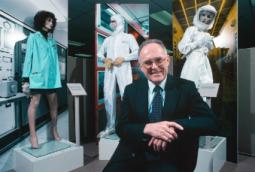
In 1965, Intel co-founder Gordon Moore observed that the number of transistors per square inch on integrated circuits had doubled every year since the integrated circuit was invented, which eventually led him to predict that this trend would continue into the foreseeable future.
Moore’s predictions have undeniably acted as the platform for the digital 21st century. According to a new report from IHS Inc., the impact of the ongoing innovation, invention and investment in technology is likely to enable continued advances in the future.
The report, titled “Celebrating the 50th Anniversary of Moore’s Law,†details how the activity predicted by Moore five decades ago drives technological change and has created tremendous economic value along with driven social advancement.
An estimated $3 trillion of additional value has been added to the GDP, including another $9 trillion of indirect value in the last 20 years, due to the speed of innovation that Moore predicted, according to the report. Without Moore’s discovery, technology would currently be at 1998’s level of sophistication.
Advanced digitally technology has resulted in high-speed Internet connections for 40 percent of the world’s households, as well up to 150 billion incremental barrels of oil that could potentially be extracted from discovered global oil fields. Researchers can perform 1.5 million high-speed screening tests per week, enabling the development of new material such as bio-fuels and feedstocks for plant-based chemicals.
Moore himself has said that the industry has been creative in continuing to increase the complexity of chips. His law has acted as an unspoken agreement between the electronics industry and the world economy that motivates engineers, investors and entrepreneurs to innovate.
Innovations in technology that stem from Moore’s Law are likely to remain a foundational force for growth in the next decade, according to a press release. Shrinking, more power-efficient technologies will give birth to and further data sharing, self-driving cars, drones, smart cities and smart homes.
Related posts:
- Circular Economy Model Offers Manufacturers Efficiencies, Leading to Economic Growth and Social Impact
- NJ Health Foundation Partners With Stevens Institute of Technology to Advance Innovative Technologies and Breakthrough Research
- Greater Newark Mini Maker Faire Upcoming Calling DIY’s etc.
- Universal Display’s EVP and CFO Participates in Live Audio Cast at Upcoming Tech Conference
- SXSW Student Pitch Competition Ramps Up for Digital Media Startups

