

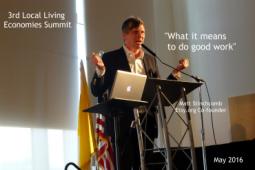
At the third annual Local Living Economies Summit in Jersey City, N.J. on May 12, 2016, Alfa Demmallash, co-founder of Rising Tide Capital, a New Jersey-based not-for-profit helping urban entrepreneurs, introduced Etsy.org co-founder Matt Stinchcomb and emphasized his growing involvement in social entrepreneurship, particularly in the area of economic development.
Demmallash described Stinchcomb as someone who is “not only creative in the ways in which he thinks about problems and their solutions, but he is also someone who is deeply committed to understanding the underlying values out of which we act.”
Stinchcomb’s talk at the conference focused on Etsy’s not-for-profit, Etsy.org, also known as The Good Work Institute. Stinchcomb began by sharing the story of Etsy, which led him into a professional and personal journey, and the founding of The Good Work Institute.
“I came to the conclusion that I am here to do good work,” Stinchcomb said, explaining that he reached this epiphany after much soul searching. Stinchcomb then went on to define “what it means to do good work,” which is the title he chose for his talk at the conference.
Stinchcomb’s path to social entrepreneurship began with his serendipitous opportunity to become part of Etsy’s startup team. According to Stinchcomb, Etsy, based in the Fort Greene section of Brooklyn, was launched in an apartment that Stinchcomb shared with Etsy founder Rob Kalin. Kalin was doing odd jobs such as carpentry, which included housing a table saw in their apartment to make handmade wooden computers that he sold locally.
A pivotal, if not life-changing, moment occurred when Kalin spontaneously offered to build a web site for their landlord as payment for their rent, even though he had never built a web site before. The travails of building the site eventually led him to two of his future Etsy co-founders, Chris Maguire and Haim Schoppik. At a later point, both agreed that a web site dedicated to those who make things would be more appealing than eBay –which was the most turned-to outlet for handmade goods at that time.
“I bet that no one else wants to put their stuff on eBay. Because I put my heart and soul into it,” posed Kalin about the handmade products he made, according to Stinchcomb. “I bet I am not alone,” he said.
Soon after that seed was planted, Etsy was born in 2005 as an online marketplace for buying and selling handmade vintage goods. Haim and Maguire developed the first site. Today, approximately 1.6 million small businesses sell their goods on Etsy.
Kalin asked Stinchcomb, a musician traveling with his own band at the time, to join Etsy to handle its marketing. Having no prior experience, Stinchcomb’s first marketing initiative for the new web-based business was to print posters that he placed around Brooklyn—just as he would for his band. The poster showed a boy throwing a rock at a manufacturing plant which Stinchcomb, in hindsight, said he sees as a statement about how the team viewed Etsy at the outset.
“It really gets to the sentiment behind Etsy in the beginning,” Stinchcomb said. “No one was a business person coming into this.” He added, “We were very much approaching this as artists—and making something not for a certain segment of the market, but with the people who were co-artisans.”
There was no business plan. The commission was determined by being a bit more competitive than eBay. They first went with their instincts, but then listened more and more to the growing Etsy community.
“Just by talking to people who were using the site and were frustrated formed our product development,” Stinchcomb said. Etsy Labs launched because they had excess space in their new quarters. This brought them even closer to the local community which, in turn, helped them grow faster. Etsy moved from $200,000 in gross merchandise sold on the site in its first year to $2.4 billion last year, on which Etsy bases its commission revenue. It has also grown to more than 800 employees worldwide.
Stinchcomb shares his excitement about the sheer volume of small businesses that are benefiting from the Etsy business model.
“I question that everything has to scale. That everything has to grow and become really big. Certainly not just growth for growth’s sake,” Stinchcomb asserted. “But when I see this growth I know that this actually represents a big number of small things, rather than a small number of very big things. That to me is really the way for economic development, more in keeping with the way that natural systems work.”
Tying in that 19% of those selling on Etsy community support themselves, Etsy’s economic impact hits home to Stinchcomb. He also realized other value was emerging from Etsy, such as the creation of a tight community of artisans, which empowered individuals to gain a foundation for their work via appreciation from others, reduce time spent at an unsatisfying job and increase time spent with family.
“Through all of these other benefits that Etsy was providing that I realized it is all about people.” This was the great lesson Stinchcomb learned that motivated him to enter social entrepreneurship which brought him to support the “Local Living Communities” conference. His initial foray into the economic aspect of Etsy began in 2007 when the company, as a whole, read the book “Deep Economy,” by Bill McKibben.
“It put into words what I was actually already seeing in Etsy. It introduced me to the topic of local living economies and what that actually means,” Stinchcomb said. “This is really about relationships, community and using business as way of building relationships, community, and connections and place.”
At that time, Stinchcomb also personally explored Buddhism that deepened his understanding and views on “interdependence.” Then he added the influence of an economics book written by E.F. Schumacher called “Small is Beautiful” and a convergence began that also included the birth of his child. From this, he realized he wanted to do “good work.” He gave thought to alternative paths to do that, but he realized that the “sheer reach that Etsy had” offered the greatest impact in the world.
In 2011, the first Etsy conference was held and Stinchcomb felt a true shift had begun in how the team was thinking about Etsy. Speaker Judy Wicks planted the seed of “business as the engine for impact. Business can be beautiful.” This became the mission of Etsy and Stinchcomb’s personal mission—which later led him to the opportunity to do something independent of Etsy in social entrepreneurship.
Etsy.org was founded and is now known as The Good Work Institute. Its mission is “to develop transformational business education programs that foster the confidence, clarity, and compassion needed to work in ways that regenerate our lives, our communities, and the planet.”
At first, its mission was focused on entrepreneurship, but the team realized that not everyone is an entrepreneur and with that the mission was extended to all those who work and how they work.
“Impact may be inside a large organization, running a not-for-profit, it may be as an entrepreneur, or a parent or a teacher or spiritual leader,” said Stinchcomb. “We all work, and we all have the ability to bring about change and impact in the world.”
Stinchcomb shared a key conclusion, “Our work can be an expression as to how we see ourselves in relation to the world.” He stressed that good work recognizes interdependence across everything, “the whole living world,” its natural systems and all people. By recognizing interdependence and including it in decision-making, compassion is cultivated.
Stinchcomb then shared his six principles for doing good work, and he drew extensively upon well-known authors and experts, interweaving quotes with each principle. They included: Charles Eisenstein, ”Sacred Economics,” E.F Schumacher, Charles Fishman, “Walmart Effect,” Buckminster Fuller, Kenneth Boulding and others.
His six guiding principles for doing good work are:
“Learn from and operate in harmony with natural systems”
This involves an emphasis on constructing a strong local economy that is more resilient and works with a large number of small things, rather than dependence on one large thing. This is strengthened through diversity and connections. He explained, “In nature, nothing is wasted.”
“Nourishes the whole human”
Stinchcomb explained that through work, we have the ability to nourish the body, mind, and spirit of somebody. It is something to strive for in how we work to let people reach their full potential.
“Invokes community”
This concept stresses that work is an opportunity to bring people together and when that occurs, compassion and inter-connectedness is cultivated.
“Embodies integrity”
This begins with the concepts of business and ethics. One cannot occur without the other. It touches the products and services we make and how it honors the customer and the potential to address problems via the choice we create.
“Aims to be great, not big”
One should not create something that enriches one stakeholder at the expense of all the others. Consider whether your work makes the world a better place and what it would be like if you were not there.
“Leaves room for mystery”
Be open to the idea that there is magic out there. Avoid a fixed way of thinking. Be okay about not knowing.
By working with these principles in mind, Stinchcomb believes that one’s focus is on regeneration and that benefits everyone. The Etsy team also realized that as they applied these principles they gained a competitive advantage over other marketplaces.
A marketplace that “honors the human behind all these things, turned out to be our greatest strategic advantage. That is what differentiates us from other online marketplaces,” Stinchcomb said.
In conclusion, Stinchcomb offered four steps in “how to do good work” that revolved around the choices we all make about work. He urged the audience to: “Pause, Look deeply from within, Make the choice that ends the most suffering for the most people and places, and Do that always!”
He ended by encouraging the audience to ask, “What’s the choice that will always create the most good?”
Related posts:
- Behance Co-founder Scott Belsky Shares his “Creative” Journey at NJ Tech Meetup
- Live.me Founder Yuki He Shares Entrepreneurial Journey at 2018 Women’s Entrepreneurship Day Summit
- Edge Therapeutics Founder Discusses the Entrepreneurial Resourcefulness that led to his Startup’s IPO
- Social Impact Company Leaders Gain Recognition in The MO 100 Top Impact CEO Ranking, Big Path Capital Opens Applications
- Rutgers CUEED Hosts Etsy Craft Entrepreneurship Workshop; 8/31 Deadline

