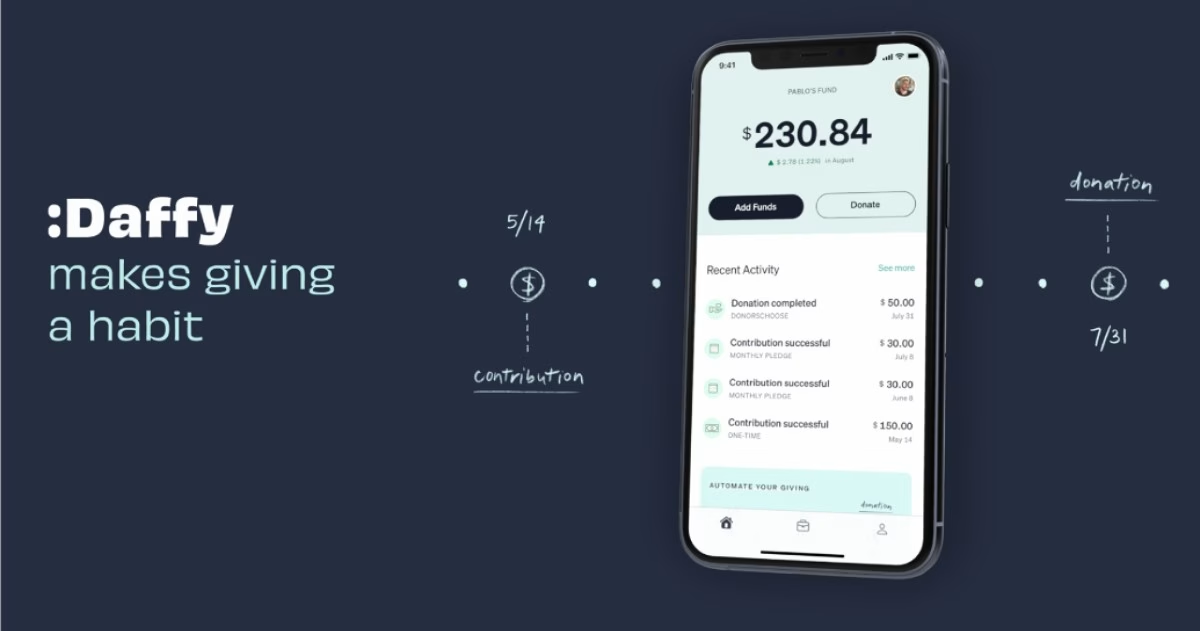
The five-year-old fintech startup has proven there is a large and broad market for individuals who want to participate in philanthropy and value the advantages of donor-advised funds, which include no fees.
Donor-advised funds (DAFs) were once seen as tools for ultra-high-net-worth donors, typically associated with large financial institutions, high minimums, and multiple fees.
Daffy, a modern DAF platform launched in September 2021, believes charitable giving grows faster when it is accessible and easy to adopt as a personal habit.
That bet appears to be working.
In its newly released 2025 Year in Review, Daffy reports record growth across membership, contributions, assets, and charitable distributions—and says it now ranks among the top 10 DAF providers in the United States by number of accounts, now entering its fifth year.
The Significance of Daffy’s Top 10 Status
Daffy manages over 16,000 donor-advised fund accounts, making it larger than 99% of DAF providers nationwide and surpassing several established platforms. This is a notable achievement in a sector that has traditionally prioritized fewer, larger donors over broad accessibility.
It removes barriers by letting anyone donate to over 1.7 million U.S. charities, with no minimums and industry-low fees.
Daffy’s core belief is that people give more and more consistently when they set aside funds for charity in advance. Co-founder and CEO Adam Nash explains that planning for generosity makes giving easier to sustain over time. He joined with Alejandro Crosa to launch the nonprofit.
Significant Growth Metrics
Daffy’s 2025 report highlights four key metrics:
- Contributions: Members set aside more than $470 million for charity in 2025
- Assets: Total charitable assets rose to over $720 million
- Donations: More than $125 million was distributed to registered nonprofits
- Membership: 16,000+ DAF accounts, putting Daffy in the Top 10 by account count
Industrywide, DAFs grew 18% year-over-year according to the Donor-Advised Fund Research Collaborative. Daffy reports growth at more than four times that rate.
Sustained Growth in Giving Over Time
While growth is important, sustained participation is equally critical. Daffy’s report highlights behavioral indicators showing that members continue to use their accounts over time.
Since Q1 2022, Daffy reports that members have donated an average of 3.3 times more than in their initial quarter. Nearly 45% of all donations are recurring, providing nonprofits with more predictable funding for budgets, staffing, and programs.
Donation sizes range from a median of $100 to individual gifts as large as $5 million, demonstrating that Daffy supports both everyday donors and large contributors within the same platform.
The company has received over $125 million in DAF transfers from other providers since launch, with a median transfer of approximately $10,000 and some transfers exceeding $1 million.
A Distinctive Payout Rate
One of the most closely monitored DAF metrics is the payout rate, which measures how much money moves from donor-advised accounts to operating charities over a specific period.
Daffy reports a 55% payout rate in 2025, meaning that for every dollar members set aside in 2024, more than half was distributed to charities in 2025. The report compares this to a 25% industry average.
Daffy positions itself as both a rapidly growing platform and one that distributes funds to charities at a higher rate than typical DAF benchmarks.
Stock-Based Giving Drives Growth
Stock contributions are the primary driver of Daffy’s 2025 results.
Total contributions reached $470 million, a 141% year-over-year increase. Daffy reports that December 2025 alone exceeded $200 million, surpassing the total contributed in all of 2024 within a single month.
Two trends contributed to this growth:
- Publicly traded stock donations: Members contributed more than $213 million, a 230% increase from 2024—reflecting growing awareness of the tax advantages of donating appreciated securities.
- Private company stock donations: Through Daffy’s Private Stock Donation Program and Daffy for Work, members contributed over $90 million in private company stock in 2025. This area has historically been limited to founders and senior executives with specialized access.
Nash suggests that private stock donation programs could become standard during tender offers and structured secondary transactions, as they help employees manage taxes and unlock new charitable contributions.
A Disruptive Fee Model
Daffy’s business model addresses a major challenge in donor-advised funds: fees that accumulate over time.
Unlike many DAF providers, Daffy does not charge asset-based or investment management fees, aiming to maximize funds available for charitable causes. It also offers no minimums, flat-rate pricing, native crypto support, family giving tools, and public matching campaigns.
These features are designed to encourage year-round giving rather than limiting activity to once a year.
Members can select from 17 pre-approved portfolios, recommend custom portfolios from over 500 ETFs, and use Custom Liquidation to hold individual stocks before they are sold.
The Future
Daffy’s 2025 Year in Review demonstrates the impact of designing a DAF as a consumer product. It supports recurring giving, broad participation, and low friction, while accommodating large and complex donations such as public and private stock.
Daffy’s goal is to serve as a “401(k) for giving.” It is where individuals set aside charitable dollars, invest them tax-free, and establish consistent gifts through recurring contributions.
Daffy’s momentum suggests a broader shift in philanthropy. It provides tools that scale by making generosity easier to practice more frequently and over time, rather than by concentrating wealth.
Related posts:
- Demand for 3D Printers Expected to Grow 24% Annually through 2021
- AR Navigation Startup Hires Former Google Executive as new CEO, Closes Series A
- Smart City Development Continues to Grow Globally, According to Navigant Research
- NYCEDC’s Economic Snapshot Highlights January Employment Gains
- Catholic Entrepreneurs Vie in Upcoming OSV Innovation Challenge Demo Day for Three $100K Prizes