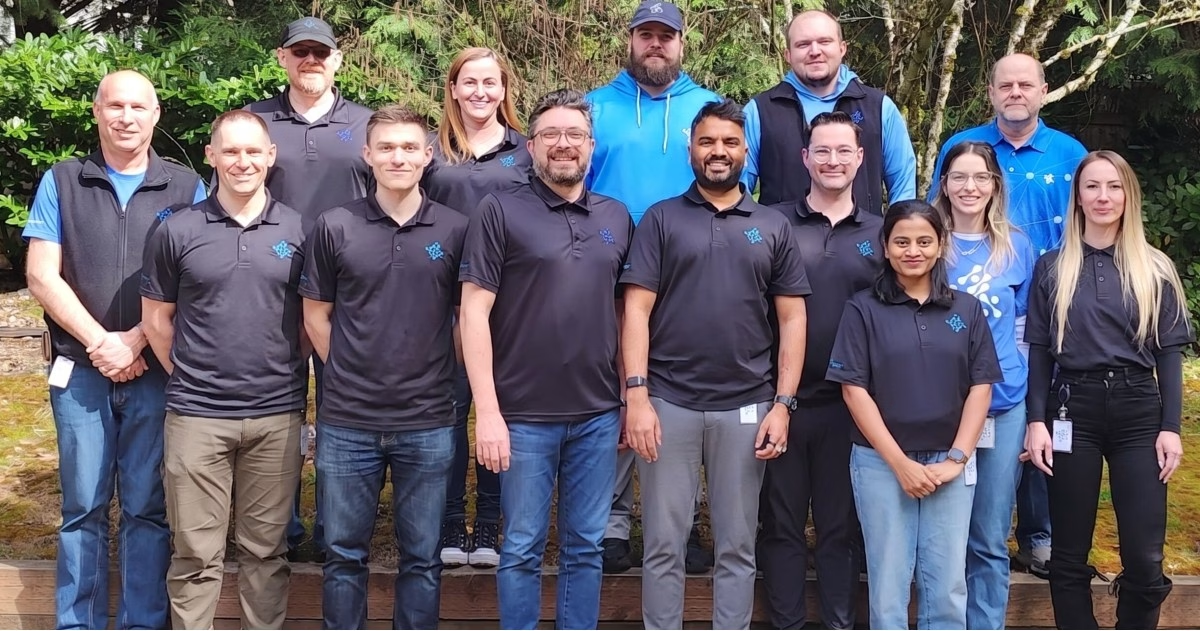
The Bellevue-based optical AI company Alitheon has secured funding to expand global deployment of its FeaturePrint® technology, a patented solution that authenticates physical goods without labels, tags, stickers, or barcodes.
Emerald Technology Ventures led the round with participation from eBay Ventures and continued backing from existing investors. Funds will be used to support the company’s push to scale its machine vision and optical AI platform across industries. Targeting will be in areas where product authenticity, traceability, fraud prevention, and supply chain security are increasingly critical.
The company developed what it calls “biometrics for things.” Its core technology, FeaturePrint®, uses a standard camera to identify the unique surface characteristics of a physical object, creating a digital fingerprint that can be used to verify the item’s identity over time.
Alitheon Targets Global Supply Chain Trust With Optical AI
For decades, companies have relied on external identifiers such as barcodes, QR codes, RFID tags, labels, stickers, serial numbers, and packaging markers to track and authenticate products. But those markers can be removed, damaged, copied, replaced, or counterfeited.
Alitheon’s technology solves that problem by identifying the object itself.
FeaturePrint captures the inherent microscopic surface details of an item and turns them into a unique digital identity. That allows businesses to verify a specific physical asset—not simply recognize a product category or model type.
The company says this enables true 1-to-1 serialization without adding anything to the product.
Alitheon’s technology is positioned as a new layer of authentication for global supply chains. Uses include industrial gears and aerospace parts, as well as healthcare products, luxury goods, collectibles, and recommerce items.
“Biometrics for Things” Creates a Zero Trust Framework for Physical Goods
Alitheon describes FeaturePrint as a Zero Trust framework for physical objects. In cybersecurity, Zero Trust means nothing is assumed to be legitimate until it is verified.
Alitheon applies that concept to physical goods by requiring an item’s digital fingerprint to be confirmed before it is accepted as authentic.
“Securing support from such powerhouses proves the world is ready for digital-first serialization, provenance, and traceability,” said Roei Ganzarski, CEO of Alitheon. “We aren’t just identifying goods; we are powering the trust layer of the global economy, providing a level of security that additives and standard AI simply cannot match.”
The company says its technology is backed by more than 55 issued patents, giving it a strong intellectual property position in the emerging physical-to-digital identity market.
Emerald Technology Ventures Leads Series A1 Round
Alitheon’s funding comes as companies across industries are working to improve supply chain visibility, reduce counterfeit risk, and strengthen product-level traceability.
The Series A1 round lead, Emerald Technology Ventures, is a venture firm focused on industrial technology, energy, advanced materials, and sustainability-related innovation.
“At Emerald, we look for technologies that solve fundamental industrial challenges at scale,” said Gina Domanig, Managing Partner at Emerald Technology Ventures. “Alitheon’s ability to provide 1-to-1 serialization without the need for labels or tags is a game-changer for global supply chains.”
Domanig added that Alitheon’s Zero Trust framework for physical goods provides “the essential data integrity required for the future of automated manufacturing and logistics.”
As manufacturers, logistics providers, marketplaces, and regulated industries face greater pressure to prove product origin and authenticity, technologies that can securely connect physical assets to digital records are gaining momentum.
eBay Ventures Backs Trust Infrastructure for Recommerce
eBay Ventures’ participation is notable because of the growing importance of authentication and provenance in e-commerce.
As more consumers buy and sell high-value goods through online marketplaces, trust becomes central to the transaction. Buyers want assurance that an item is genuine.
Sellers want to reduce disputes and fraud. Marketplaces want stronger infrastructure to support confident transactions.
“As recommerce continues to grow, trust and provenance are becoming increasingly important across high-value categories,” said Henri Jaanimägi, Global Head of eBay Ventures. “Alitheon’s ‘biometrics for things’ represents an important step forward in the broader trust infrastructure needed to support more transparent and confident buying and selling experience.”
In particular, authentication systems that do not rely on removable or counterfeit-prone labels could have broad implications for marketplaces and resale platforms.
It could lead to enhanced verification of luxury products, electronics, collectibles, automotive parts, industrial components, and other high-value items.
Why Alitheon’s FeaturePrint Technology Matters
Currently, a label, tag, or barcode says what an item is supposed to be. But if the marker is copied or moved to another object, the system can be compromised.
With Alitheon’s approach the object itself becomes the identifier.
Some industries valuing such improvements include: Manufacturing to verify individual parts, tools, components, and finished goods; Healthcare to authenticate medical devices, pharmaceutical packaging, or regulated products; Luxury goods to protect brands and consumers from counterfeits; Automotive and aerospace to track mission-critical parts with precise digital identity; and Logistics to improve chain-of-custody records across complex global supply networks.
Alitheon’s FeaturePrint aims to provide that secure bridge between the physical item and its digital record.
Alitheon Positions Itself as a Physical-to-Digital Identity Leader
With the new $8 million Series A1 funding, Alitheon is positioning itself as a leader in physical-to-digital identity, a category focused on linking real-world assets to secure digital records.
Their opportunity is not only anti-counterfeiting, but building a broader trust layer for commerce, manufacturing, and global trade.
By using optical AI to verify the identity of individual objects, reliance on added materials, external markers, or traditional machine learning classification ends.
The additional capital will help expand FeaturePrint’s deployment across global supply chains at a time when trust, transparency, and traceability are becoming business-critical priorities.
Related posts:
- Venture Debt’s Record $68.8B Driven by Startups Seeking Flexible Capital
- Factory Secures $50M Series B to Power an LLM- and IDE-Agnostic Future for Agent-Native Development.
- Surgicure Technologies Secures Seed Funding for Device Enhancing Patient Breathing
- Omnidian Gains $87M in Funding to Revolutionize Renewable Energy Investment
- Lowercarbon Capital and Gradient Ventures Invest $9M in Quilt for Advanced Residential Heat Pump System