The two-plus-year-old startup has grown quickly, supported by major tech companies and leading angel investors, to provide an agnostic platform that no longer restricts developers to a single editor, a specific large language model, or a limited workflow.
Factory, a rapidly growing player in AI-assisted software development, has launched Droids, a new category of autonomous development agents, and also announced a $50 million Series B round led by NEA and Sequoia Capital, with participation from NVIDIA, J.P. Morgan, and notable angels including Frank Slootman, Nikesh Arora, and Aaron Levie.
Founded in 2023 and based in San Francisco, Factory now has support from a group of top-tier investors who share a common vision: the next decade of software will be driven by developers who see agents not as a novelty, but as a fundamental capability.
The launch comes right after Droids hit #1 on Terminal Bench, the standard used by top AI coding tools.
But Factory’s larger move is philosophical: instead of forcing developers into one IDE, one model, or one interface, the company is creating a fully agnostic platform—LLM-agnostic, IDE-agnostic, remote/local-agnostic, and interface-agnostic—that adapts to how teams already work.
An Agent Platform That Refuses to Lock You In
Most AI coding tools tether users to a single editor, a large language model, and a limited workflow. The Factory breaks that pattern. With Droids, developers can delegate tasks from the Terminal, their IDE, Slack, Linear, or the browser—and switch models seamlessly behind the scenes.
Power users can run Droids in headless mode to connect agents into scripts, CI/CD triggers, or custom workflows, creating automations that adapt to each codebase and team’s needs.
This is more than just convenience; it is a structural decision that makes Factory’s platform resilient to the rapid evolution of the LLM landscape. As better models emerge or compliance requirements shift, teams aren’t stuck waiting on a vendor to catch up or renegotiating their stack. They can simply point Droids at the best model for the job—today and tomorrow.
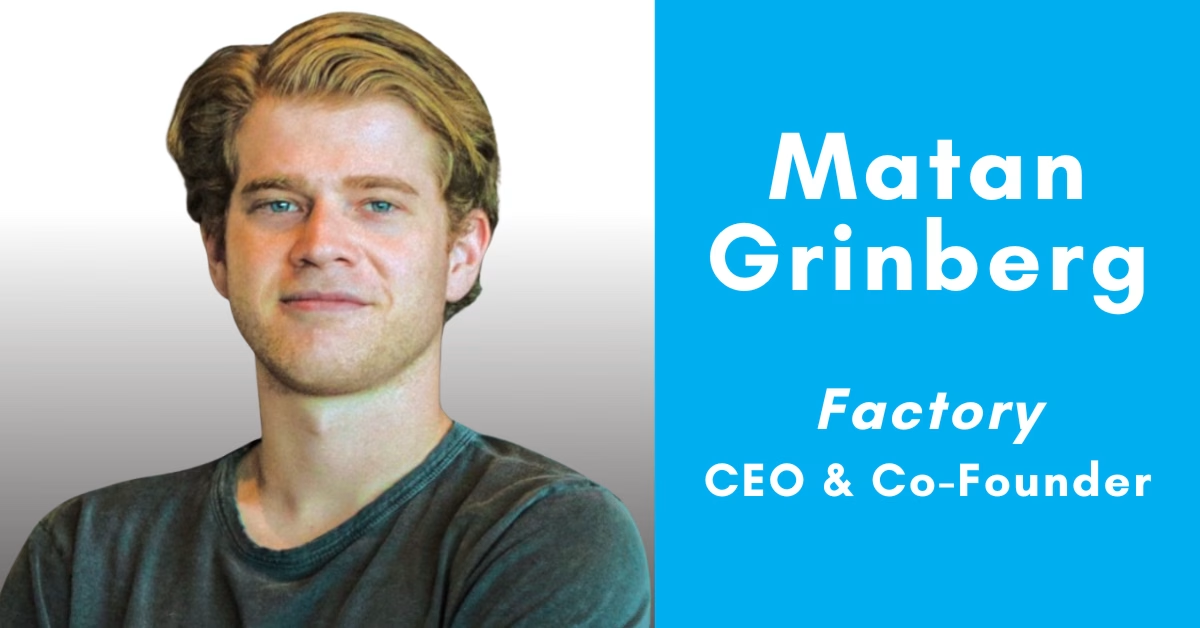
“Agent-native development presents the most substantive shift in software development since the move to the cloud,” said Matan Grinberg, Factory’s co-founder and CEO. “Agents will not replace developers, but developers who are fluent with agents will rapidly outleverage and outpace developers who are not.”
From Autocomplete to Delegation
Factory defines its approach as agent-native development—a step beyond autocomplete or chat-in-the-sidebar. Droids don’t just suggest snippets; they shoulder-scoped tasks across the software lifecycle. Out of the box, teams are using Droids for:
- Migrations & refactors
- Feature development
- Codebase Q&A and documentation
- Code review
- Incident response
Importantly, Factory integrates across the engineering stack including GitHub (code collaboration), Slack (team messaging), Jira (project tracking), Datadog (monitoring), Sentry (error tracking), Google Drive (file storage), and more—so Droids can gather context like a human engineer.
This “context” means agents can understand dependencies, coding conventions, and past choices, rather than treating each task as if it were brand new.
Enterprise Momentum—and Measurable Outcomes
Ernst & Young, NVIDIA, MongoDB, Zapier, Bayer, and Clari are among the companies whose engineers use the platform. They are achieving significant results, including delivering features 31 times faster, reducing migration times by 95.8%, lowering on-call resolutions by 95.8%, and enhancing code quality, along with reclaiming time for architecture and design.
While results will vary by team and workflow, the pattern points to a practical truth: well-scoped agents can compress toil and unlock higher-leverage engineering work.
“Factory is demonstrating what no other agentic coding platform has: that enterprises will adopt and scale this technology when it delivers real value,” said Madison Faulkner, Partner at NEA. “We believe their ability to combine enterprise adoption with scalable unit economics strongly positions them to lead and define the future with an entirely new category of agent-native development.”
Why Agnosticism Matters Now
The investment round underscores a clear thesis: in a world where LLM performance, pricing, and risk profiles shift quarterly, vendor lock-in becomes a liability. Factory’s LLM-agnostic approach allows teams to choose models based on data sensitivity, latency needs, or top-quality performance for a specific task—without the need to refactor workflows.
The same principle applies to IDE and interface agnosticism: a Java team in IntelliJ, a Python group in VS Code, or an ops team living in Slack can all collaborate with Droids without switching tools.
That flexibility also benefits governance and cost management. Organizations can direct workloads to compliant or cost-effective models, switch between remote and local execution, and obtain the observability required for audits and post-incident reviews—essential for scaling AI in regulated or security-sensitive settings.
A Clear Future for Agent-Native Teams
Factory plans to enhance Droids’ capabilities, enrich the organizational context, and expand its integration surface.
The two-plus-year-old startup’s hiring across engineering, research, and GTM supports its drive to become the default operating layer for agent-driven software delivery.
Its Series B is a bet on choice—choice of model, editor, interface, and execution environment—and on a delegation-first future where engineers orchestrate agents to do meaningful work across the lifecycle.
The agent-native era is about elastic engineering. Factory’s Droids, and the agnostic platform beneath them, offer a compelling blueprint for enabling teams build with AI on their terms.
Related posts:
- PwC Study: CEO Confidence Falls as AI Gap Widens
- Croissant launches with $24 million in seed funding, accelerating its Fintech Platform
- Takeda Awards $13.8M in U.S. Grants to Advance STEM Education and Food Access
- Y Combinator Announces Summer Fellows Grants for Technical College Students
- Wiley and AWS Partner to Transform Life Sciences Research with AI Agents