

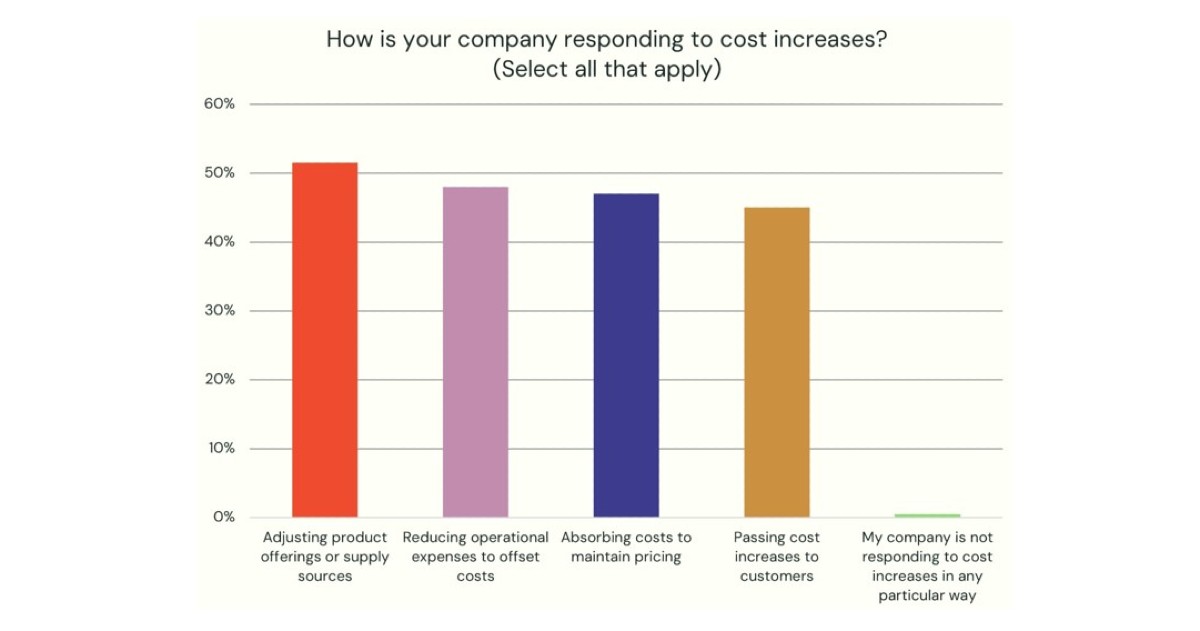
The executives surveyed indicated their companies are responding to newly implemented tariffs by passing costs on to customers and making strategic changes to their supply chains and gaining efficiencies from AI.
As U.S. businesses continue to navigate a volatile economic landscape, a new survey by pricing lifecycle management leader Zilliant highlights how companies are reacting to recent tariff policy changes. According to the Business Tariff Impact Survey, 44% of U.S. companies plan to pass increased tariff-related costs directly to customers, while many others are reshaping their supply chains and leveraging AI to fine-tune pricing strategies.
The survey, conducted by Censuswide in early April 2025, polled 400 senior executives—including CEOs, CFOs, and chief revenue officers—from U.S. companies generating over $250 million in annual revenue. The findings reveal a blend of strategic adaptations and cautious optimism in the face of continued economic pressure.
A Pricing Crossroads: Tariffs, Competition, and Strategy
One of the survey’s clearest takeaways is that tariffs are becoming a central factor in pricing strategy, with nearly half of respondents identifying them as a significant challenge. In fact, 23% listed tariff-related costs as their primary pricing concern for 2025, second only to competitive pricing pressure (33%).
These pressures are driving strategic shifts across the board:
- 44% of respondents plan to pass tariff costs on to customers, risking potential backlash but aiming to protect margins.
- 42% are actively shifting suppliers or sourcing regions, reconfiguring their global supply chains in response to new trade dynamics.
- 45% are cutting operational expenses to cushion the financial blow of rising input costs caused by tariffs.
These statistics suggest that tariffs are not just a cost burden—they’re a catalyst for major organizational change.
CEOs and CCOs Take the Lead on Pricing
Recognizing the high stakes of pricing decisions in today’s economy, companies are elevating the responsibility to top leadership. The survey found that 98% of businesses have a designated internal champion responsible for overseeing pricing strategy.
- 87% of Chief Commercial Officers (CCOs) said they currently make pricing decisions.
- 68% of CEOs also claimed that role.
- Interestingly, 56% of all respondents believe the CEO should ultimately be the final decision-maker, a sign of how critical pricing strategy has become to overall business performance.
“Pricing isn’t just a finance function anymore,” said Pascal Yammine, CEO of Zilliant. “It’s a boardroom issue, directly tied to revenue, customer relationships, and competitiveness. Companies that don’t elevate pricing strategy to executive leadership risk falling behind.”
Economic Pressures and Optimism in Balance
Despite the hurdles, business leaders are largely confident in their ability to remain profitable. 87% of respondents expressed optimism about maintaining profitability, thanks in large part to technology-driven pricing solutions.
This confidence is reflected in how companies are turning to artificial intelligence to stay agile:
83% are using AI-based pricing tools to navigate economic volatility.
These tools are helping companies implement more targeted, data-driven pricing strategies instead of across-the-board increases, enabling them to remain competitive while protecting margins.
“AI is becoming a critical enabler of modern pricing strategy,” said Stephan Liozu, Chief Value Officer at Zilliant. “Rather than relying on broad adjustments, businesses can now respond to market changes with precision and speed, staying ahead of both cost challenges and competitive threats.”
A Long-Term Outlook: Price Wars and Policy Uncertainty
Looking ahead, executives foresee more disruption. When asked about their top concerns for the next 12 to 24 months, “competitive price wars” and “tariff and trade uncertainty” were tied at 27% each. These twin pressures suggest businesses will need to stay nimble, balancing the need to maintain margin with the reality of a hyper-competitive, policy-driven environment.
“While tariffs are a clear and present issue, pricing strategy is also being shaped by how competitors respond,” added Liozu. “That’s why leading organizations are using real-time data and AI to ensure they’re not just reacting—but adapting intelligently.”
Sector-Wide Impact
The survey drew responses from a wide range of industries—including manufacturing, finance, IT/telecom, retail, construction, and education—underscoring the broad impact of tariffs across the economy. While sector-specific details will be released in Zilliant’s full report next week, early indicators show that supply chain flexibility and pricing agility are key survival tools across all verticals.
The Bottom Line: Transparency and Tech Are Key
Zilliant’s leadership emphasized the importance of maintaining transparency with all stakeholders as companies adjust to new cost realities.
“Customers and partners can accept changes, but only if they understand them,” said Yammine. “Transparency will be key to retaining trust during this pricing evolution.”
At the same time, technology is rapidly transforming how pricing is approached. With AI playing a growing role in decision-making, companies have an opportunity to turn economic headwinds into a strategic advantage.
As the global trade environment continues to shift, U.S. companies are clearly feeling the pressure—but they’re not standing still. Whether by passing costs to customers, revising supply chains, or using AI to optimize pricing, the message from the Zilliant survey is clear: businesses are adapting—and in many cases, accelerating.
Related posts:
- Women-Led Tech Startup Launches Smartphone App for Global Fight of COVID-19
- Cannabis Startup Receives Key Investment from Strategic Real Estate Firm
- National Small Business Week Celebrates Small Business Contribution to U.S. Economy
- Is Your Business Idea Worth over $200,000? Miller Lite Might Think So!
- Book Excellence Awards 2017 Honors “No Cape Needed” as Finalist in Leadership Category

