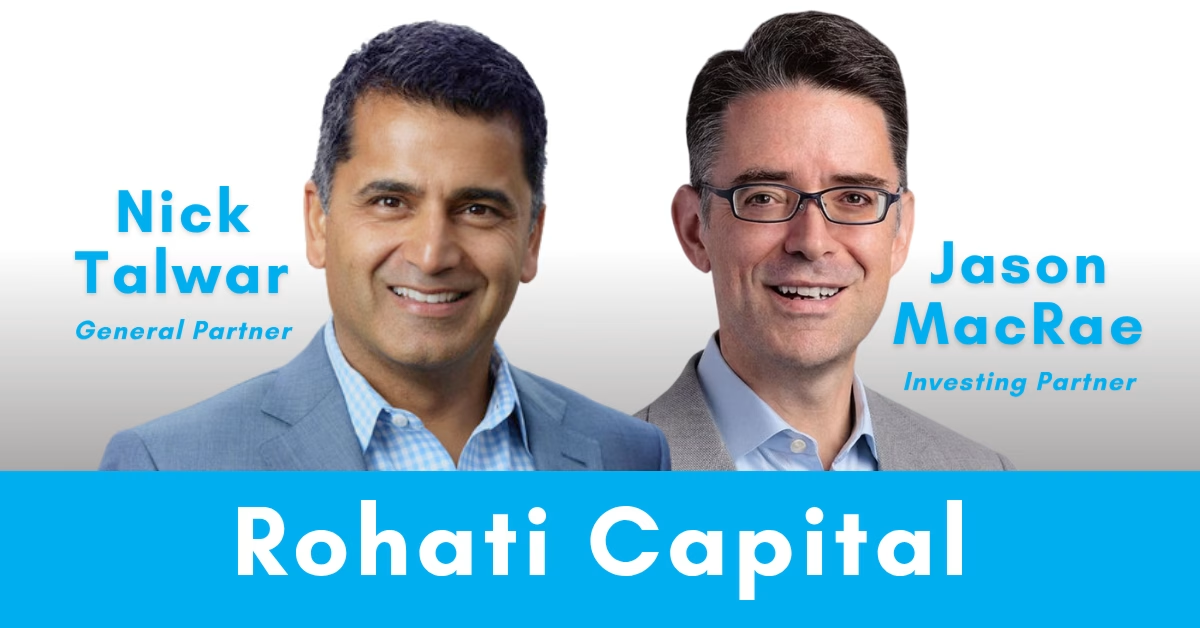
Former Amazon operators behind Amazon Lending are bringing their data-driven investing playbook to venture capital through a hybrid strategy that combines top-tier venture fund exposure with direct startup investments.
PALO ALTO, Calif. — Rohati Capital has closed its inaugural venture fund, Rohati Fund I, at $50 million, exceeding its original $30 million target. The operator-led investment firm looks to create a new model for individual investors and family offices seeking access to venture capital.
Founded by former Amazon executives and operators, Rohati Capital is building a global venture platform. Their goal is to combine investments in a select group of specialist venture funds with direct investments in companies sourced through those same managers.
Rohati Fund I’s structure is approximately divided 50-50 between venture fund positions and direct company investments.
According to the firm, the model is designed to diversify across investment vintage, geography, and strategy, This approach retains some of the economics and potential path to distributions associated with direct venture investing.
The fund’s portfolio includes positions in prominent venture firms Union Square Ventures and Gradient Ventures, as well as early direct investments in companies including SpaceX.
Rohati Fund I Attracts Global Investor Base
Rohati Fund I attracted limited partners from across the technology, investing and entrepreneurial communities. Its investor base includes 17 Amazon executives and alumni, 27 professional venture and private equity investors, 20 founders and CEOs, and eight chief investment officers spanning 16 countries.
The firm’s strategy grew partly from the founders’ experience building Amazon Lending.
Managing Partner Nick Talwar and several members of the Rohati team worked together at Amazon. During that period they they helped create and operate the company’s lending business for marketplace sellers.
Launched in 2014, Amazon Lending used machine learning to evaluate businesses that conventional credit-scoring approaches could overlook. Within two years, the business had extended more than $1.5 billion in credit across the United States, United Kingdom, India and Japan.
Rohati’s founders say they saw a similar access problem in venture capital.
Top-performing venture returns have historically been concentrated among a relatively small group of managers. This made gaining access to those firms difficult, particularly for individual investors and family offices without longstanding institutional relationships.
“We saw the same pattern in venture that we saw at Amazon: a category that works, but best at the very top, and mostly for people who already have a way in,” Talwar said.
A Hybrid Approach to Venture Capital Investing
Rohati’s investment model attempts to address what the firm sees as shortcomings in the traditional choices available to private investors.
A conventional direct venture fund can offer significant upside and a clearer route to distributions. However, investors typically receive exposure to one manager, strategy, and vintage.
Fund-of-funds structures can provide broader diversification, but they often add an extra layer of fees and can extend the time required to generate distributions.
Rohati instead backs a concentrated group of venture managers and then invests directly in selected companies sourced by those same firms.
The structure gives Rohati exposure to multiple venture ecosystems. This allows it to build a direct portfolio around companies identified by managers it already knows and backs.
“We built Rohati so individual investors can get the economics and the path to distributions of a direct fund, with diversification across vintage, geography and strategy, assembled from the best ideas of managers we have worked alongside for years,” Talwar said.
Former Amazon Leaders Build Rohati Capital Team
Rohati’s leadership brings experience across technology, machine learning, financial services, private equity and venture investing.
Talwar previously ran Amazon Lending, led Visa’s North American credit card business and held senior leadership positions at Uber before becoming CEO of CircleUp. He has also served on the boards of companies including PayJoy and Rapido.
Investing Partner Jason MacRae was Amazon’s director of research science, where he developed models supporting Amazon Lending before succeeding Talwar as general manager. He later became chief data officer at Capital Group.
Other partners include former HighPost Capital Senior Managing Director Steven Himmel; former Guggenheim Capital Management Asia leader K.V. Dhillon; Charles Elkan, Amazon’s first Fellow and former global head of machine learning at Goldman Sachs; and Alen Rakipovic, who has built AI systems at Amazon and Meta and currently serves as a principal engineer at Stripe.
That operating network is central to Rohati’s investment approach. The firm says its access to venture managers and investment opportunities stems from relationships its partners developed as executives, operators, and board members.
Rohati Targets U.S. AI Ecosystem and Select Global Markets
Most of Rohati Capital’s exposure remains concentrated in the United States. The firm has focused on Bay Area venture managers and companies participating in the rapidly expanding artificial intelligence ecosystem.
Internationally, the firm takes a fund-first approach by partnering with local investment specialists. India is currently Rohati’s largest market outside the United States. The firm focuses internationally on companies it believes can become category leaders.
With its first $50 million fund now closed above target, Rohati Capital is betting that its combination of operator experience, venture relationships and direct investing can provide a differentiated entry point into an asset class traditionally dominated by large institutional investors.
Related posts:
- Plural Brings Over $1B in Energy and Compute Infrastructure Assets to Market
- NEW INC Professional Development Program Seeks Members for September
- Small Business Resources Essential for Starting a Business
- American Venture Capital Investment’s Two-Year Hot Streak Surpasses $130 Billion in 2019
- PlayAI Announces Seed Round and Releases New Model for Generative AI Conversations