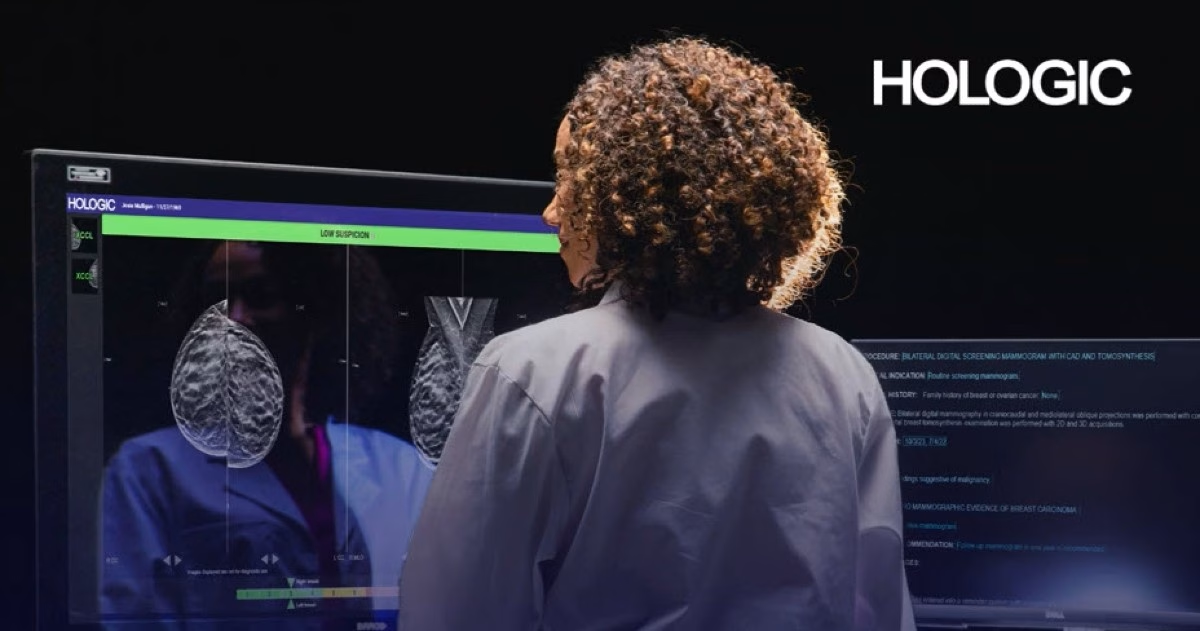
Hologic’s AI-powered mammography technology gives great encouragement to women as it looks to help identify hard-to-detect breast cancers, such as Invasive lobular.
The Society of Breast Imaging Symposium presented new evidence that suggests Hologic’s AI-powered mammography technology may help radiologists identify one of the most challenging forms of breast cancer to detect: invasive lobular cancer.
The new data, shared over the weekend in Seattle, adds to growing interest in how artificial intelligence can support breast imaging specialists as they review mammograms for a wide range of cancer subtypes.
For Hologic, the findings strengthen their case that AI can serve as an important assistive tool in breast cancer screening, particularly when subtle patterns may be easy to miss.
“Invasive lobular cancers are more challenging to detect on a mammogram because of their unique characteristics,” said Mark Horvath, President of Breast & Skeletal Health Solutions at Hologic. “In the study, AI maintained high sensitivity for flagging these cancers, including some that had been interpreted as negative at a prior screening.”
Why invasive lobular cancer is harder to detect
Approximately 10% to 15% of breast cancer cases are invasive lobular, according to the research that Hologic cites. Unlike more common ductal cancers, which begin in the milk ducts, invasive lobular cancer arises in the milk-producing lobules and often grows in a linear, diffuse pattern.
That growth behavior can make the cancer less conspicuous on mammograms. That increases the risk that it may be detected later, at a more advanced stage.
Accordingly, technologies that can help radiologists spot subtle abnormalities have become an increasingly important area of innovation in women’s health.
Massachusetts General Hospital study tested Hologic’s AI on 239 cases
In a retrospective, single-center study conducted at Massachusetts General Hospital in Boston, researchers reviewed cases of invasive lobular cancer diagnosed over a 10-year period.
The cases were divided into two groups:
- 195 cancers detected by a radiologist during routine screening
- 44 “false negative” cases diagnosed within a year of a screening exam were initially interpreted as negative
Researchers then used Hologic’s Genius AI Detection solution to retrospectively analyze all 239 confirmed cases of invasive lobular cancer.
According to the company, the AI technology identified and correctly localized close to 90% of the confirmed invasive lobular cancers in the study cohort. It also identified 43% of the cancers that had initially been interpreted as negative during routine screening.
Those findings suggest that AI may help flag cancers that are difficult to identify solely through standard mammographic review.
AI’s role in breast imaging continues to expand
Breast cancer remains a major global health challenge, recognized in the company’s recent research referenced announcement. This indicates that 1 in 20 women worldwide will be diagnosed with breast cancer during their lifetime.
If current trends continue, annual global breast cancer cases could reach 3.2 million by 2050, with 1.1 million breast cancer-related deaths per year.
Against that backdrop, AI-enabled screening tools are gaining attention for their potential to improve accuracy, support radiologists under heavy workloads, and help detect cancers earlier.
Hologic says its Genius AI Detection technology is designed to highlight suspicious areas on mammograms at the radiologist’s workstation during interpretation. This supports faster and more confident reads.
This is achieved through the company’s deep learning algorithm, which has been trained on data from a large and diverse patient population.
Hologic also highlights 3DQuorum imaging technology
In addition to the invasive lobular cancer study, Hologic also used the Society of Breast Imaging Symposium to spotlight its 3DQuorum imaging technology during a lunch-and-learn session with breast imaging experts.
The company says 3DQuorum uses AI to reduce the number of 3D mammography image slices radiologists need to review, while maintaining image quality, sensitivity, and accuracy.
The company’s pitch is straightforward: help radiologists work more efficiently without compromising clinical performance.
Study limitations remain important
While the findings are promising, the study comes with important limitations.
The Massachusetts General Hospital analysis was retrospective and conducted at a single institution, which may limit how broadly the results can be applied.
The study also did not assess false-positive rates, recall rates, biopsy outcomes, or how AI use might affect real-world patient management in a live clinical setting.
Because the AI was evaluated after the fact rather than during actual screening decision-making, the results show what the technology was capable of identifying in theory. It did not measure the impact it would have had on care in real time.
The cohort also included only invasive lobular cancer cases, meaning the study was not designed to compare AI performance across different breast cancer subtypes.
The Future Role of AI in Breast Cancer Screening
Even with those limitations, the research adds another data point in favor of using AI as a supportive tool in mammography rather than as a replacement for radiologists.
That matters because the strongest emerging use case for AI in imaging is often not autonomous diagnosis.
Rather, it is to assist clinicians in prioritizing attention, reducing oversight, and potentially detecting cancers that present in harder-to-read ways.
Tools that can improve the detection of difficult cancers may become increasingly valuable in routine screening workflows. The new evidence presented at SBI suggests that AI may play an important role in invasive lobular cancer.
Related posts:
- Ideally Launches Ideally Canvas in the U.S. After $10M Series A to Accelerate AI-Powered Market Research
- WorkWave Partners with Cleaning For A Reason to Support Women Fighting Cancer
- Satisfaction with Social Media Remains Low, while Pinterest Shines and Facebook Struggles in ACSI Report
- Building a Culture of Success in Your Company
- Amazon Report Highlights Small Business Jobs in 2021 Empowerment Report