When Mysty Rusk founded the San Diego Angel Conference (SDAC) in 2019, she had some clear goals in mind. But she did not foresee what reaching those goals would fully entail or how quickly she and her supporters would see success. SDAC, part of the University of San Diego (USD) School of Business program, recently hosted its pitch competition for the third consecutive year, awarding a record $500K to five early stage tech companies.
Just one year ago Rusk faced a challenge that no one could have foreseen—the threat of cancelling their second annual conference due to COVID-19 rippling across the U.S. She had only days to decide once lockdowns began. Postpone, cancel or go virtual? Those were her choices and she chose to adapt her model, taking the very advice investors give to entrepreneurs. She decided the conference would go virtual.
“I had little familiarity or experience in the technology that is necessary to run a virtual event,” she explained. “But we did it! The entrepreneurs received funding to go forward and I think we may be the only organization that can claim to have run two major events during the pandemic.”
The first virtual event was a success and she received accolades for taking the risk. But Rusk actually had one driving thought behind her decision. She knows startups—and she knew that entrepreneurs coming to that Conference were seeking funding that might determine whether or not they would be able to move forward. She was pleased they went on to fund $200K at the virtual event.
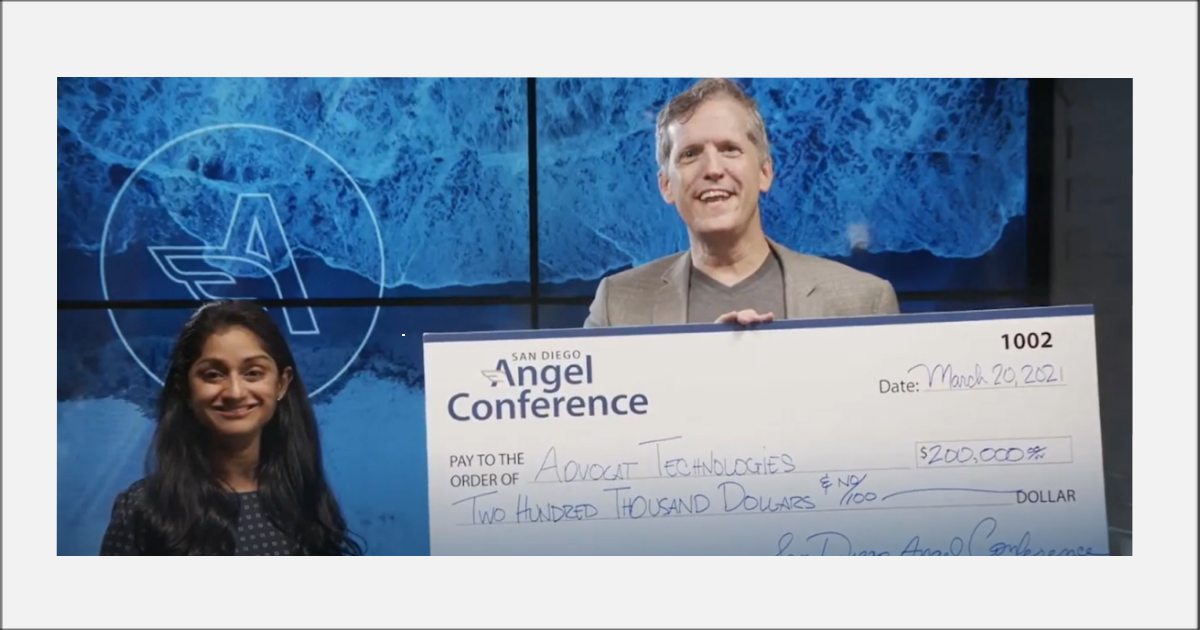
This year Rusk, the SDAC team, and the event sponsors were thrilled to award even more funds to the pitch winners—with the $200K top prize going to Advocat Technologies that provides AI-guided legal intake, research, and drafting for Fortune 1,000 legal teams. The remaining $300K was shared evenly among the four other finalists: ChargeNet Stations, Digital Proteomics, Fluid Power AI, and Verity.
For Advocat Technologies CEO Pradnya Desh, the first place prize is timely, and the connections the company made at the event suggest even more opportunities for their startup in the future.
“We are grateful to the SDAC angels and honored to be among the innovative companies competing. This funding enables us to further develop our technology and ramp up marketing as we advance our mission to leverage AI to enable attorneys to do more in less time. We are especially appreciative of the knowledge, tools, and connections we’ve built through SDAC – truly invaluable.”
With so much satisfaction at day’s end by all of those involved, they could not believe how much was achieved in three short years—and more so in the 12 months from the first virtual event to the second. Clearly, the pain points that led Rusk to establish the angel group and host the annual conferences were being answered.
“I saw two challenges happening that I thought founding SDAC could answer. One was that entrepreneurs were frustrated that there were not enough active angel investors in the area. On the other side the angels were unengaged because they felt the pipeline of innovative startups was weak,” said Rusk.
She came up with a way to jumpstart SDAC’s first event that would address each side’s challenge. Accredited angel investors would purchase units in a fund and form an LLC. This would create a large pool to be invested on the day of the event. Not only would entrepreneurs see a sizeable reward for attending, but the angels would be able to participate in more high quality deals through the pool.
After holding two virtual conferences in a row, Rusk could not be more pleased about the activity that occurred. Last year it was pharma/biotech and related industries helping to fight COVID-19, such as equipment and cleaning innovations. This year saw a continuation of that hot trend—but also greater activity in HR and benefits due to the paradigm shift in employment and working routines, as well as innovation addressing the change in consumer buying habits prompted by the lockdowns.
She remains optimistic despite the huge challenges now facing the country. After having experienced recessions and mega challenges in areas such as energy that seemed daunting at the time, she has seen the innovations that emerged in response—noting that tech startups such as Airbnb and Uber arose out of the last recession to go on to become unicorns.
“We hold on during these periods and we do what we have done in the past. We invent our way out.”
Read How Keiretsu Angel Groups Made 2020 a Banner Year despite the Pandemic
Related posts:
- Shamrock Capital Closes Oversubscribed $813M Content Fund IV
- 2024 Thiel Foundation Fellows Announced
- NJEDA Announces Additional $5 Million for Sustain & Serve NJ Program
- Alternative Internet Raises $40 Million, Offering New Approach to Content and Community
- Lexion raises $20M Series B, expands AI-powered contract management solution to broader user base