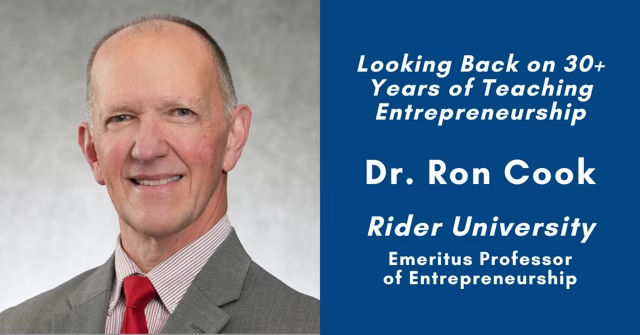
Dr. Cook is an Emeritus Professor of Entrepreneurship at Rider University’s Norm Brodsky College of Business. Over more than 30 years, he started and led the Center for Entrepreneurial Studies and the Small Business Institute®, a student consulting program.
He served five years as Rider’s Associate Dean for Graduate Business, managing five graduate programs and contributing to the college’s leadership team. He received the Distinguished Teaching Award and the Elliott Distinguished Service Award at Rider.
Q: Over your 33 years at Rider, how did you shape the entrepreneurship curriculum and the Center for Entrepreneurial Studies, and how has the student profile and approach to entrepreneurship education changed?”
A: I started at Rider University in 1993 as an assistant professor, and there was no entrepreneurship program.
I launched the student consulting class (Small Business Institute program) and worked with other departments to create an interdisciplinary major.
At that time, many students came from small or family-owned businesses, so it made sense to create a curriculum to help them succeed as founders and operators. Early on, I focused on developing new courses and building a strong academic base for entrepreneurship.
As student interest grew, particularly through the student consulting class’s visibility and real-world impact in the local business community, entrepreneurship began to gain traction across campus. I wanted students to be able to test their ideas while still in school, which led me to envision a collaborative space where they could brainstorm, experiment, and learn beyond the classroom.
That vision became reality in the mid-2000s with the establishment of the Center for Entrepreneurial Studies, which I served as Executive Director alongside my role as professor.
Through the Center, we further expanded entrepreneurship beyond the classroom and into the community. I started a volunteer mentoring program and created the Student Venture Experience course to help students launch ventures and track their progress.
With strong alumni support, we also began a veteran entrepreneurship program to help local veterans and service members start businesses.
We established an advisory board to guide the Center’s growth, launched a business concept competition for high schools, and supported Rider students in regional and national entrepreneurship competitions.
Today, the Center for Entrepreneurial Studies serves as the hub for all entrepreneurship activity at Rider—overseeing majors and minors, student consulting projects, community engagement, and experiential learning.
More recently, the addition of a MakerSpace has enabled students to test ideas and develop prototypes, further strengthening the program’s hands-on nature.
Q: How has the teaching of entrepreneurship changed over your career?
A: In my 33 years, one of the biggest changes I’ve seen is how entrepreneurship is taught and who it reaches. It started mainly for business students who wanted to start companies, but now it’s open to students from many fields.
Students in the arts, sciences, and humanities now choose entrepreneurship majors or minors to build businesses based on their own skills, like a dance major opening a studio or a science student turning research into a business.
Equally important is the shift toward cultivating an entrepreneurial mindset. Today’s curriculum emphasizes creative thinking, problem-solving, and informed decision-making—skills that employers value across startups, large organizations, government, and nonprofits alike.
While many graduates do go on to launch ventures, others apply these capabilities within established organizations, demonstrating how entrepreneurship education has become foundational rather than niche.
Q: Were students as enthusiastic about becoming entrepreneurs as they are today?
A: Initially, enthusiasm for entrepreneurship was limited to students aiming to improve family businesses or start their own companies. There was some focus on part-time ventures to gain marketing experience, but today, students have more options and opportunities.
We did not initially offer an entrepreneurship minor, but once it was introduced, students from other majors were able to gain entrepreneurial experience. They could pursue careers in their primary fields while exploring side ventures or consider full-time entrepreneurship later.
Before joining Rider, I started a part-time venture that taught me lessons in sales and service quality, which I brought to my career and teaching. That is a minor popular among non-business students.
Q: What classes or programs did you find most nurturing, and what ones were added later in your career as the entrepreneurial landscape changed?
A: One of the first classes I developed, the Seminar in Small Business Consulting (SBI Program), produced significant student success. In this course, students serve as external consultants, helping small firms address challenges and explore new opportunities.
Students assess client needs, draft consulting contracts, and deliver project outcomes. Clients receive comprehensive reports, which are submitted to a national competition. Rider students have won six national titles and more than 15 second- and third-place awards.
It is rewarding to see students adapt to new business environments, learn industry dynamics, identify client issues, and provide actionable recommendations. Supporting their development of critical thinking in real-world contexts is gratifying.
Another key course is New Venture Planning, a required capstone where students research a business idea, develop a business plan, and assess its viability. The course teaches a structured evaluation process to distinguish real opportunities from ideas. It emphasizes research, communication, and understanding customer needs.
Family Business is another valuable course. Drawing on my background and that of many students, I invite multigenerational family business owners to share their experiences. Helping students navigate conflict, succession, and intergenerational growth is rewarding.
As the major expanded, we introduced an international entrepreneurship class focused on strategies for selling products and services abroad. We also created a required freshman course, Innovation and Entrepreneurship, to help students develop creativity and an entrepreneurial mindset. This course emphasizes identifying and evaluating potential venture ideas.
Q: What were the key milestones in the programs that advanced entrepreneurship at the University?
A: Over my 33 years, I continued to pursue ways to fully address entrepreneurship, exposing students to as many aspects as they could later tap into in their careers.
While the entrepreneurship program began as a student consulting program, we expanded it to include an entrepreneurship minor, which was key to making it popular among non-business students. Also, securing sponsors for the SBI program allowed me, as director, to offer travel stipends to student winners whose projects were chosen as national finalists, highlighting student achievement and enhancing the program’s reputation.
The involvement of highly successful entrepreneur Norm Brodsky significantly advanced our efforts to promote the entrepreneurial mindset and demonstrate entrepreneurship’s relevance to all students. Recently, the Center partnered with the Business in Action program, a required freshman course where student teams develop products to sell.
The Center’s MakerSpace supports prototype development and exposes all business students to entrepreneurship.
Establishing the Center’s advisory board supported a range of initiatives for veterans, the MakerSpace, and the SBI competition. Veterans have participated each summer for the past 13 years.
These initiatives ensure students have hands-on experience. All were possible through alumni support, as resources were not included in the regular operating budget.
Q: How did Norm Brodsky become involved in the program and the creation of a scholarship competition?
A: Norm’s involvement began years before his return to campus, as I used his materials in my classes long before meeting him. In the mid-1990s, he published the ‘Street Smarts’ column in INC magazine, which I incorporated into my courses for years, unaware he was an alumnus.
That changed in the early 2010s as the entrepreneurship major grew. I received a request from the Advancement office about an alum named Norm Brodsky. I was excited to meet the person whose articles had shaped my curriculum.
As his connection with Rider grew, Norm transformed the Center’s high school business concept competition by helping secure a four-year tuition scholarship for the winner. This scholarship is unique because it is awarded based on the creativity and potential of the student’s idea, rather than GPA or a specific skill.
Norm continued to engage with students by taking groups to INC 5000 conferences for networking opportunities. With a colleague, he created the course ‘Inside the Entrepreneurial Mind,’ bringing successful entrepreneurs into the classroom.
After the college was named in his honor, he continued teaching this course and established a partnership with Oxford University, supporting an international entrepreneurship study tour focused on innovation.
Q: What were some of the advances in the program due to Norm’s involvement?
A: Norm’s involvement helped us focus on the entrepreneurial mindset through the course he created and teaches. He wants students to apply this mindset throughout their lives and brings experienced entrepreneurs into the classroom to share their insights. Students discuss their career aspirations and receive tailored advice.
The College’s namesake actively teaches entrepreneurship, which is highly significant, and his involvement has greatly contributed to fostering the entrepreneurial mindset. Norm has also played a key role in developing the international entrepreneurship study tour at Oxford and supports students with travel scholarships to make this experience accessible.
His engagement has led to the establishment of a naming-day speaker event featuring individuals who embody Norm’s entrepreneurial spirit.
Q: In broader terms, what do you see as entrepreneurial training’s role in undergraduate education?
A: Entrepreneurship training is valuable. All students should develop an entrepreneurial mindset and understand how their decisions impact organizations, regardless of their employer.
As most students will have multiple employers during their careers, they need to think creatively and develop problem-solving skills. If they start their own ventures, an entrepreneurial perspective becomes even more important.
Q: What do you look back on as some of your most personally satisfying achievements?
A: I have achieved several significant accomplishments, but I value most those that help others succeed.
In the student consulting course, I taught many talented students whose efforts benefited client companies.
I enjoyed belonging to a national association that hosts the competitions for the best student consulting projects. I had great satisfaction over the years, as my students won six national titles and several second- and third-place finishes. Seeing them receive these honors and knowing I contributed to their success is very rewarding.
Another reward was teaching students to better evaluate business concepts. When students presented ideas and asked for feedback, I would often say, “This is the best idea I have heard in a long time.” They would get excited until I added, “But I don’t know if this is a potential opportunity or just a nice idea.” I emphasized the importance of research and understanding industry fundamentals.
Many students do not realize that sales revenue is the hardest figure to estimate in a new venture. To generate realistic sales projections, they need to know the selling price, average sale per customer, and purchase frequency—essentially, how many people buy, how much they buy, and how often they buy.
I have always aimed to remain flexible and adapt to new opportunities. Collaborating with exceptional individuals has benefited the Center. While I often receive credit, these successes are the result of collective efforts by the board, students, and alumni, whose achievements I am honored to share.
Related posts:
- Cross River Provides Tech Platform and Bank Services to a New Partner, Fintech Startup SeedFi that Promotes Economic Inclusion
- Governor Murphy Cuts the Ribbon at HAX Flagship U.S. HQ in Newark
- President Obama Speaks at Global Entrepreneurship Summit at Stanford University
- Rutgers’ Seeks Applicants for “Entrepreneurship Pioneers Initiative”
- Autonomous Car Technology Testing Challenged by Consumer Watchdog In View of Disengagement Reports and Recent Fatality