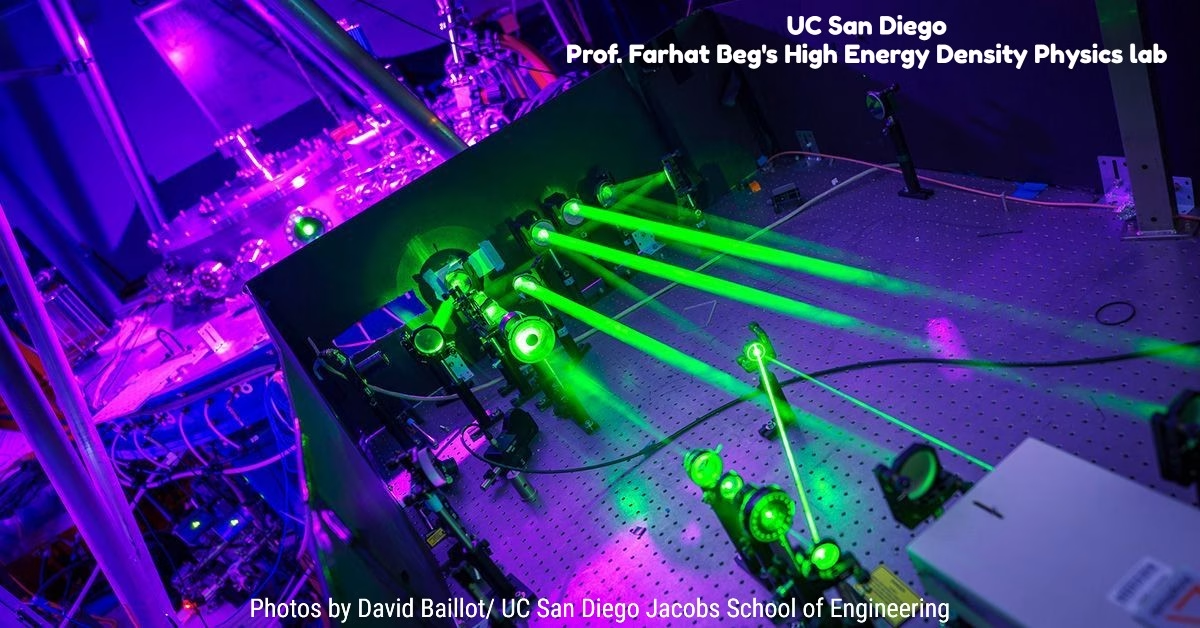
The inaugural gathering brought together top leaders and researchers from various sectors in fusion energy to explore its potential as a major contributor to California’s innovation ecosystem.
On November 13th, California hosted its first statewide fusion energy summit, “Accelerating California’s Fusion Energy Economy,” in San Diego. Over 200 leaders from science, government, industry, and academia met to discuss how the state can transform fusion research into a scalable commercial energy sector.
UC San Diego, Lawrence Livermore National Laboratory (LLNL), and General Atomics hosted the summit, with support from the U.S. Department of Energy’s Office of Fusion Energy Sciences, the California Energy Commission, and the Governor’s Office of Business and Economic Development. The event emphasized California’s commitment to leading the development of fusion as a practical clean energy solution.
Fusion energy replicates the reaction that powers the sun and stars, offering a potentially limitless, carbon-free source of baseload power. The current challenge is transitioning from laboratory breakthroughs to commercial power plants, and summit organizers positioned California as a leader in this effort.
From Breakthrough Science to a $125 Billion Industry
The summit builds on a report from the San Diego Regional Economic Development Corporation, which projects that California’s fusion energy sector could generate over $125 billion in economic impact and support up to 43,000 jobs in the next decade. This potential positions fusion as an emerging economic driver rather than a distant scientific pursuit.
Participants addressed the entire fusion value chain, including expanding research infrastructure, developing workforce pipelines, strengthening supply chains, and shaping policies to attract investment and accelerate commercialization.
“It was a great honor to hold California’s first statewide fusion energy summit at the University of California, San Diego,” said Javier E. Garay, inaugural director of the UC San Diego Fusion Engineering Institute. He noted that alignment between public and private sectors gives California a unique opportunity to address technical and commercial challenges and advance fusion deployment.
A State Already at the Center of Fusion
California already hosts two of the world’s most advanced fusion facilities, demonstrating its leadership in the field.
- DIII-D National Fusion Facility (San Diego): Operated by General Atomics for the U.S. Department of Energy, DIII-D is the nation’s only operational tokamak user facility, providing scientists worldwide with a platform to test and refine fusion concepts.
- National Ignition Facility (LLNL): In 2022, LLNL’s National Ignition Facility became the first in the world to achieve and repeat fusion ignition, where the energy produced by fusion exceeds the energy delivered by its lasers to the target. These experiments validated the fundamental physics that could support future fusion power plants.
The summit highlighted recent legislation and state incentives aimed at attracting fusion companies to California and supporting new demonstration projects. Industry representatives emphasized the need for regulatory clarity and streamlined permitting to help emerging fusion hubs develop into established regional centers.
Why It Matters for California’s Innovation Ecosystem
The fusion summit represents more than an energy initiative; it marks the next phase of California’s innovation economy.
The San Francisco Bay Area is home to a concentration of national labs and research institutions, including LLNL, Lawrence Berkeley National Laboratory, Sandia National Laboratories’ California campus, and SLAC National Accelerator Laboratory. Since LLNL’s ignition breakthrough, the region has attracted increased venture capital investment in fusion and related technologies, supporting both startups and established companies. LLNL’s new Livermore Institute for Fusion Technology now serves as a hub for translating ignition science into industry collaborations.
In San Diego, a complementary regional ecosystem is emerging. UC San Diego and San Diego State University are developing academic programs and research capacity to train the specialized workforce needed for fusion, including plasma physicists, materials scientists, data engineers, and advanced manufacturing technicians. General Atomics, based in the region, serves as a key industrial anchor by supplying precision targets for LLNL’s ignition experiments and partnering with UC San Diego on initiatives such as the Fusion Data Science and Digital Engineering Center.
For California’s broader innovation ecosystem, fusion offers:
- A new deep-tech anchor sector alongside semiconductors, AI, biotechnology, and climate technology.
- Long-term job creation in research, engineering, manufacturing, construction, and operations.
- A strong incentive for federal funding and private investment, reinforcing the state’s leadership in mission-driven science and climate solutions.
- A clean, reliable energy foundation to support data centers, advanced manufacturing, and other energy-intensive industries in California.
“California is where the future of fusion energy will be shaped,” said Tammy Ma, director of the Livermore Institute for Fusion Technology at LLNL. She highlighted the lab’s role in pushing the science forward and forging the public–private partnerships needed to grow the ecosystem.
Building a Fusion Future
San Diego is recognized as a model for regional collaboration, with the City of San Diego and the San Diego Regional EDC positioning the area as a global center for fusion research, engineering, and advanced manufacturing.
“San Diego is already laying the groundwork for a powerful fusion ecosystem,” said Anantha Krishnan, senior vice president of the General Atomics Energy Group. He stated that with strong policy support, new investment, and collaboration across government, academia, industry, and national labs, the region and the state are well-positioned to advance fusion from scientific achievement to commercial application.
The summit’s central message was clear: the first country to achieve practical fusion power will help shape the global energy future. California’s leaders believe that, with the state’s research assets, talent, and innovation culture, California can lead this effort and contribute to both its own economic growth and the global transition to net-zero energy.
Related posts:
- Drone Racing League Constructs Record-Setting Racing Drone
- More Women Involved in High Growth Cybersecurity Seeing Leadership Opportunities
- CyberSecurity Must Address Threats from Within
- Optimism for Newark Tied in Large Part to the City’s Technology in Mayor Ras Baraka’s State of City Address
- AI Use Cases in Government, Enterprise and Consumer Markets Propelling its Growth