

As a solo founder launching a startup, you have full autonomy and speed in decision-making.
However, this also presents some challenges because no single person has all the skills needed to build, market, manage, and scale a business.
Tradeoffs
Almost all solo founders face a resource constraint: time, capital, and equity.
During a startup’s early stages, funds are typically limited. That makes full-time hiring impractical. Building everything yourself conserves equity and funds, but it severely limits speed and can lead to burnout.
However, bringing on a co-founder or executive to cover a critical discipline, such as technical architecture, product design, or sales, often requires relinquishing substantial equity and control.
Finding the right balance between retaining full ownership and utilizing one’s own time versus accelerating execution is the solo founder’s dilemma.
Alternative Strategies to Fill the Skills Gap
Solo founders can leverage several distinct approaches to navigate these challenges depending on a number of factors such as runway, risk tolerance, and long-term goals:
Outsourcing
Specialized non-core activities are the easiest areas to outsource. They include legal setup, accounting, compliance, or initial UI/UX design are among the easiest areas to
The founder can tap into freelancers, external agencies, or fractional executives. This approach preserves equity while providing talent for specific needs.
Leveraging AI and Low-Code/No-Code Tools
Today’s founders have access to an expanding suite of AI-driven tools and no-code platforms.
Non-technical founders can build functional prototypes using low-code tools, while technical founders can automate marketing, copy generation, and customer support.
Automation leverages headcount, keeping it low and preserving cash.
Tapping into Advisory Boards and Mentorship
Advisory boards offer another low-dilution alternative when the challenges are not operational.
Seasoned advisors can provide industry expertise and introductions. They may take on a role in exchange for modest advisory equity (typically 0.25% to 1%).
This way, the founder gains high-quality talent with minimal ownership dilution.
Upskilling and Focused Learning
To scale a startup, the founder should distinguish between skills they can readily master and those they should delegate.
Core founder tasks may include customer discovery, value proposition articulation, and early fundraising, These can generally be learned firsthand.
When you decide to become an entrepreneur, you commit to ongoing learning. Pursuing new skills empowers founders to make informed decisions, even after they hire specialists.
Decision Framework: When to Hire, Outsource, or Learn
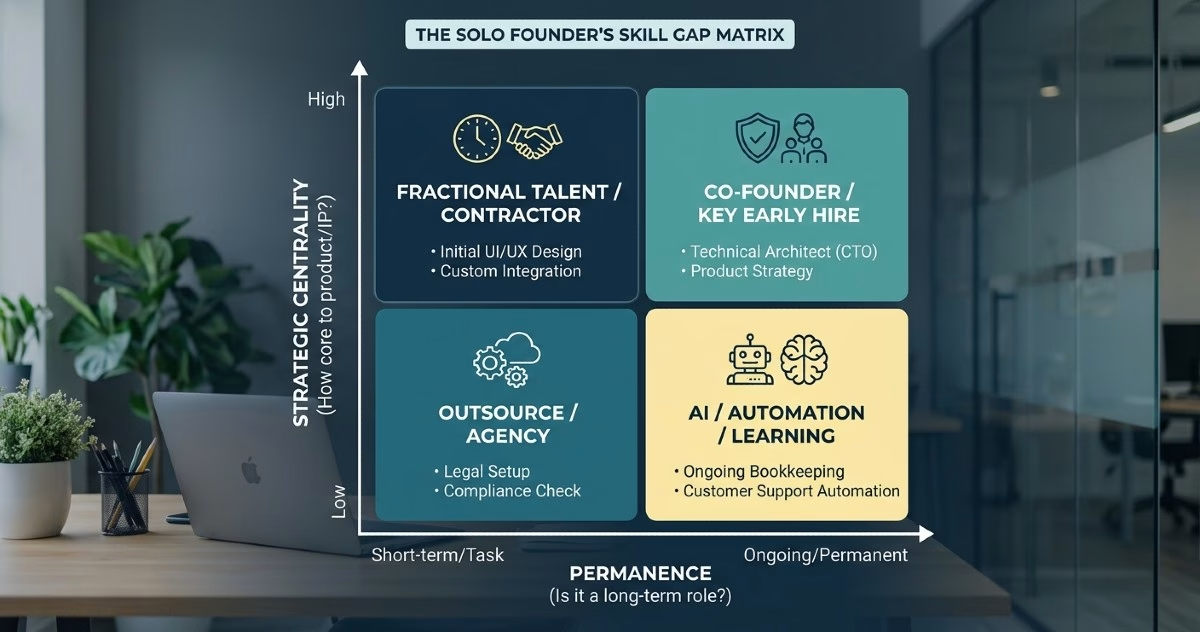
To choose the best path forward, founders can evaluate each skill gap against two criteria: whether the step or solution is central to the startup’s strategy and whether it has an ongoing role in the company.
If the skill is core to the product (e.g., proprietary algorithms or core product engineering), a technical co-founder or key early employee may be the step
However, for initial product design, brand identity, or launch campaigns, contracting specialized agency or freelance talent is appealing.
In comparison, non-core ongoing operational functions like bookkeeping or legal rely on outsourced software solutions or fractional services.
Conclusion
The solo founder’s journey doesn’t require knowing how to do everything.
It requires knowing how to source solutions efficiently.
By combining fractional talent, current automation tools, and strategic advisory relationships, solo founders can effectively cover their early skill gaps, preserve equity, and build a strong foundation for future growth.
Related posts:
- Othello’s $8M in Funding to Transform Sales with AI Coaching During Live Calls
- Innovation and Workplace Diversity Positively Linked in Accenture Report
- New Healthcare Event HLTH Launched by Jonathan Weiner and Anil Aggarwal
- SpotHero and TIBA Establish Innovation Partnership to Improve Customer Parking Experience
- Employers reduce Medical Expenditure by $40 Million through Vitals

